Sometime around the 1950s, the average woman on earth had five children. That number has been dropping ever since, and today it remains at about 2.3 globally — close enough to the replacement threshold of 2.1.
Europe is where the numbers get genuinely hard to process. Germany and Spain have been below 1.5 for years. Italy too. South Korea recorded 0.72 in 2023. Pension systems, healthcare, military recruitment, economic growth — all of these are built on the assumption that the next generation will be at least as large as the current one. In several countries, that assumption quietly stopped being true a long time ago.
How does this happen? Cities, mostly. Once people move into urban areas, the economics of family size flip completely. A child raised in an apartment costs far more than one raised on a farm where they eventually help with the work. Women who pursue education and careers postpone having children, often into their thirties, and frequently end up with fewer than they originally planned.
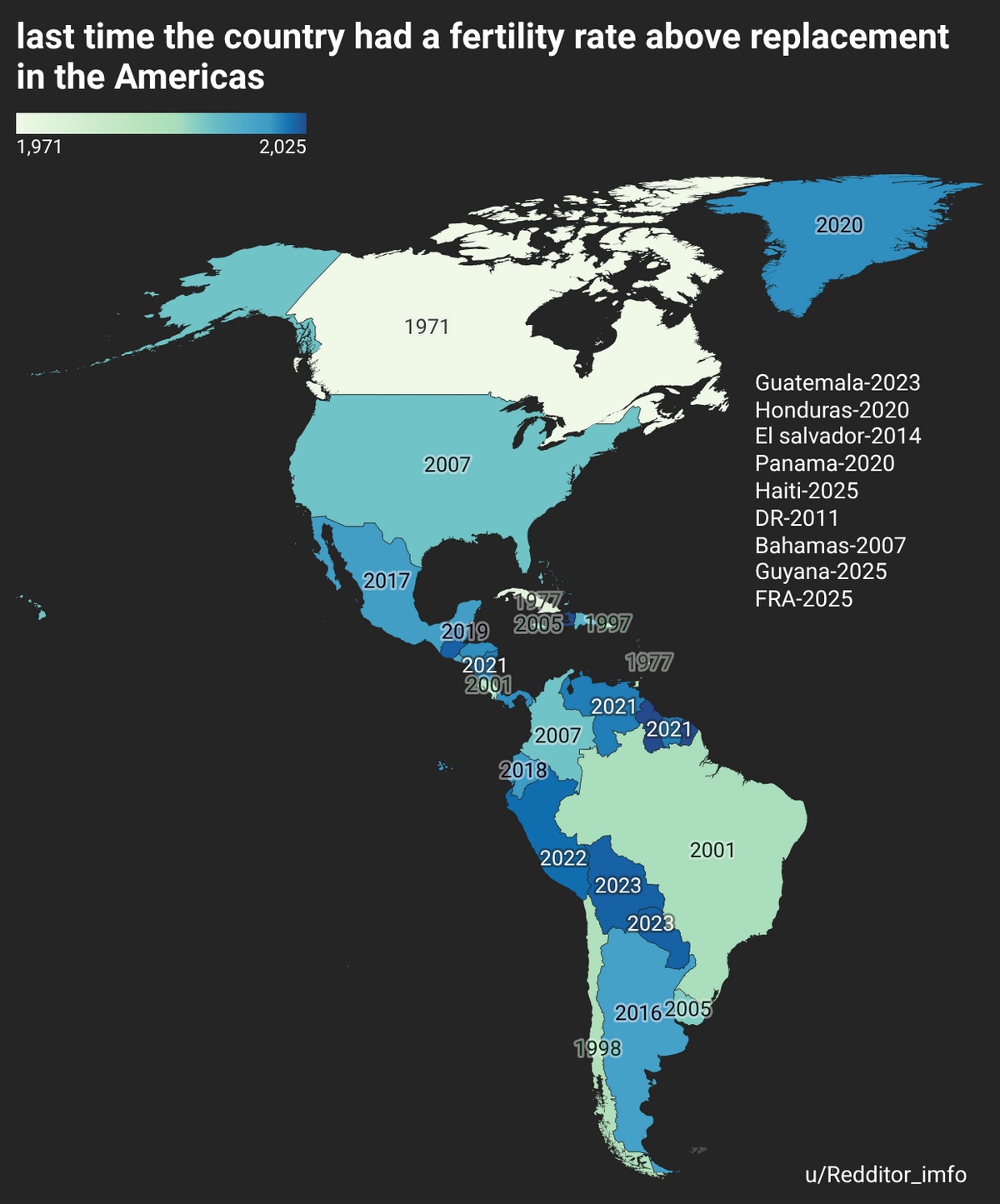
Latin America and North America are not exempt from any of this. The map below shows the last year each country in the region had a fertility rate above 2.1.
Canada got there first. The country dropped below replacement in 1971, when most of its southern neighbors were nowhere near that point. Cuba was next, in 1977 — post-revolutionary Cuba invested heavily in women’s education and that showed up in the birth rate within a generation. Argentina reached the same point in 1998, Brazil in 2001, the US four years after that.
Country / Territory
Last year above replacement
North America
Canada
1971
United States
2007
Mexico
2017
Greenland
2020
Central America & Caribbean
Cuba
1977
Jamaica
2005
Trinidad & Tobago
1977
Bahamas
2007
Dominican Republic
1997
El Salvador
2014
Chile
1998
Belize
2019
Costa Rica
~2003
Nicaragua
2021
Honduras
~2025
Panama
2020
Guatemala
2023
Haiti
2025
South America
Argentina
2016
Brazil
2001
Paraguay
2023
Venezuela
2021
Colombia
2007
Ecuador
2018
Peru
2022
Bolivia
2023
Suriname
2021
Guyana
2025
French Guiana
2025
South America spread across several decades. Chile and Brazil were among the first, crossing in the late 1990s and early 2000s. Colombia reached the same point in 2007. After that the pace picked up — most of the Andean countries dropped below 2.1 within the last seven years, with Bolivia and Paraguay both crossing in 2023.
Central America came last. By 2023 even Guatemala had crossed, with Honduras right at that threshold now.
Haiti, Guyana, and French Guiana are still above 2.1. Lower urbanization, less access to education and healthcare — the same conditions that kept fertility higher elsewhere for longer.
Canada has been offsetting its low birth rate through immigration since roughly the 1980s. Several other countries in the hemisphere are now looking at the same demographic math and working out what their version of an answer looks like — or whether there is one.