For most of human existence, high birth rates weren’t a preference. They were survival arithmetic.
Before the 20th century, roughly a quarter of children in most parts of the world didn’t reach their fifth birthday. In some regions and periods it was closer to half.
Industrialization pushed childhood mortality down. Then 20th-century public health accelerated it — mass vaccination, cleaner water supplies, antibiotics. But families didn’t immediately start having fewer children just because fewer were dying. It took a generation, sometimes two, before birth rates adjusted. During that lag, population grew faster than at any point in recorded history.
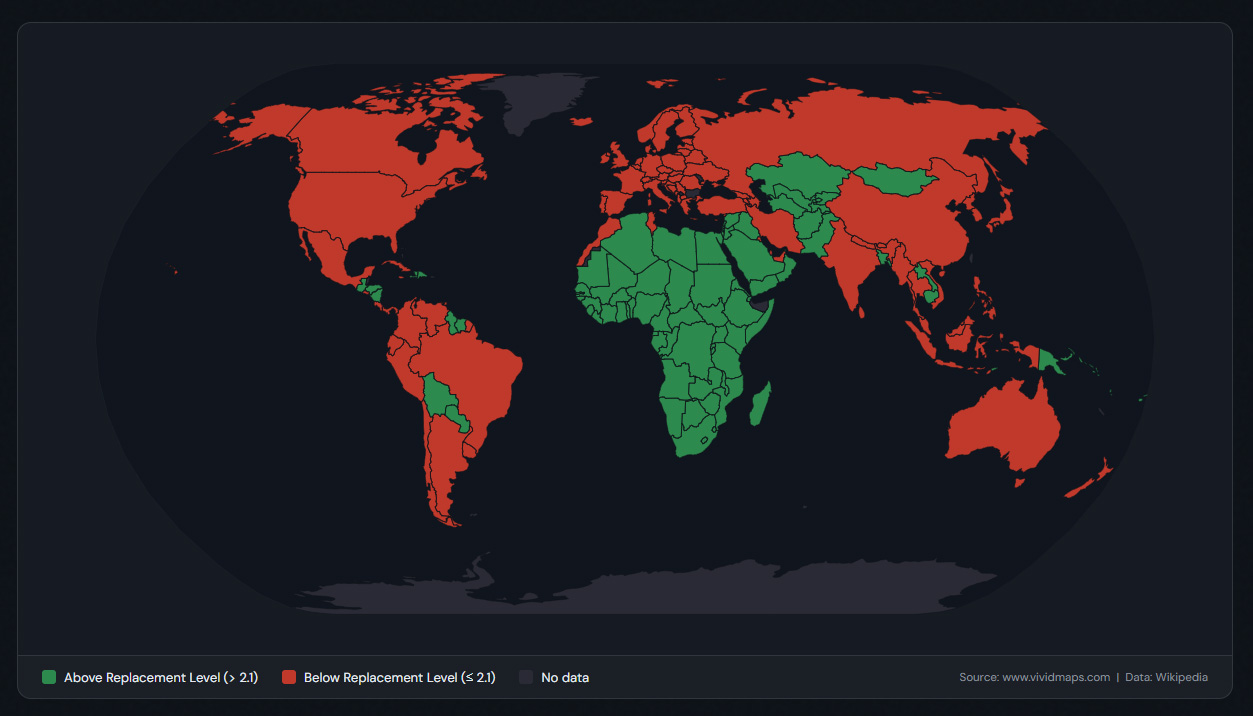
Green countries are above 2.1 children per woman — the rate at which a population can hold steady without immigration. Red is below it. Africa and much of Central Asia are green. Most of the rest of the world is not.
The whole of Sub-Saharan Africa sits well above 2.1. Chad is at 5.94, Somalia 5.91, DR Congo 5.90. The region is still in that lag period: child mortality has improved significantly over recent decades, but the economic and social conditions that eventually pull birth rates down — access to education for girls, urbanization, contraception — are running on a different timeline than they did in, say, South Korea or Iran a generation ago.
Europe and East Asia have been below replacement for a long time. Japan has been below 2.1 for close to forty years. Governments across Southern and Eastern Europe have handed out cash payments for new babies, built more daycare centers, extended parental leave — Italy is at 1.20 now, Spain 1.21. South Korea has spent more on incentivizing births per capita than almost any country on Earth and is down to 0.75, the lowest rate of any sovereign nation in this dataset.
Iran is at 1.67. Brazil 1.60, Argentina 1.51. Mexico is at 1.87. These are countries that spent decades being associated with rapid population growth. India crossed below 2.1 around 2020 and is at 1.94 now. The Philippines was at 6.0 in the early 1960s and is at 1.88 today. The perception of these places as high-fertility countries has simply not kept pace with the data.
The world average is 2.24. Above 2.1, yes, but not by much, and without Sub-Saharan Africa it would already be below replacement.
Highest fertility rates (2025)
Lowest fertility rates (2025)
1. Chad – 5.94
237. Macau – 0.69
2. Somalia – 5.91
236. Hong Kong – 0.74
3. DR Congo – 5.90
235. South Korea – 0.75
4. Central African Rep. – 5.81
234. Saint Barthelemy – 0.83
5. Niger – 5.79
232. Puerto Rico – 0.94
6. Mali – 5.42
230. Ukraine – 1.00
7. Angola – 4.95
228. China – 1.02
8. Burundi – 4.68
226. Curacao – 1.07
9. Afghanistan – 4.66
225. Andorra – 1.10
10. Mozambique – 4.62
224. Malta – 1.11
Interestingly, Israel is at 2.75 — high for a country at its income level, the product of religious demographics anddecades of active government support for larger families. Kazakhstan is at 2.95, Uzbekistan 3.45, Tajikistan 2.99. Most of these countries are still heavily rural, and in practice it’s urbanization that pulls birth rates down more consistently than any policy. Bangladesh is at 2.11, essentially sitting on the line. Lebanon is at 2.21 and has been falling for years.
For most of the 20th century, the population concern dominating political thinking was overpopulation — too many people pressing against limited food and resources. In parts of the world where birth rates are still high, that concern is still real. But in most of Europe, East Asia, and now growing parts of Latin America, the actual problem governments are dealing with is the opposite: workforces shrinking faster than pension systems can absorb, and smaller cities losing residents with nothing reversing it. China ended the one-child policy in 2015 and has been running incentives to have more children ever since, with almost nothing to show for it. No country has worked out how to meaningfully raise a fertility rate once it has dropped this far.