Russia dominates the Arctic coastline. Canada has enormous Arctic territory. Greenland, Norway, Sweden, Finland – they all have northern access. However, the Arctic regions of these countries are developed unevenly, and the differences can be significant. Some have built cities and infrastructure, while others have left their Arctic areas largely uninhabited.
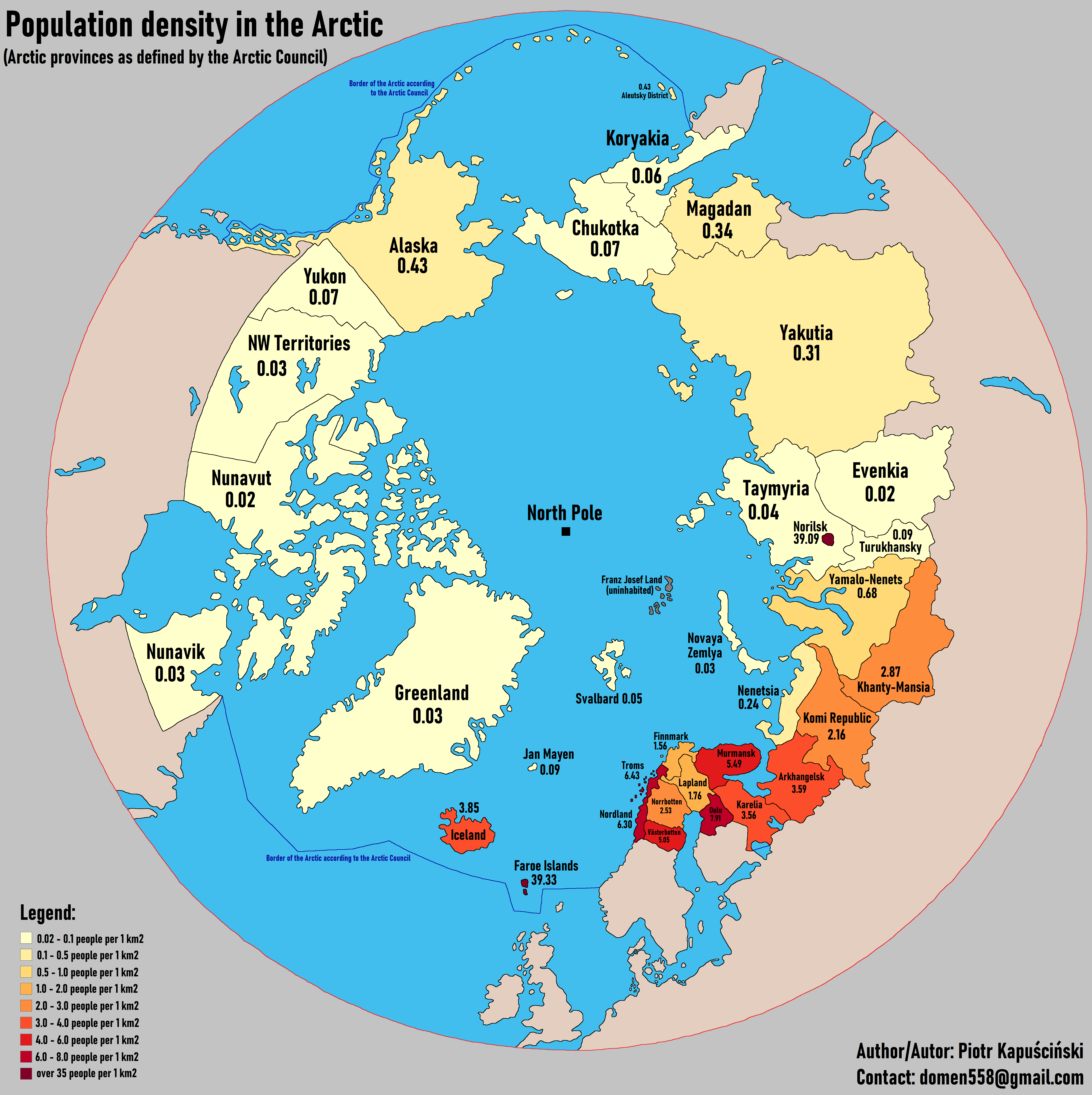
Murmansk is the largest city in the world north of the Arctic Circle. 270,000 people live there. Real city with schools, shops, apartment buildings. Families have lived there for generations. Norilsk and Yakutsk are similar – permanent Arctic settlements where people build lives.
In Canada, Nunavut covers an enormous territory but has almost no one. About 39,000 people live across 1.9 million square kilometers (733,000 sq mi). Iqaluit is the capital and largest town with around 9,000 people. The rest is empty tundra.
The map below, created by Piotr Kapuściński’s, shows population density in the Arctic.
Why the gap? Russia invested in Arctic development during Soviet times. They needed resources from there – minerals, oil, gas. Built infrastructure, cities, permanent populations. Mining operations and factories required full-time workers. Communities grew to support them.
Canada approached differently. Companies extracted resources temporarily then left. Workers came for jobs and departed. Greenland similar. The Arctic never became worth permanent development. You don’t build cities for temporary work.
The Arctic costs enormous amounts to develop. Permafrost makes construction complicated. Heating and supply chains run expensive. You invest that money only for something valuable. Russia decided the resources justified it. Other nations disagreed.
County
Subdivision
Density (per km²)
Density (per mi²)
Largest city
Population
Russia
Murmansk Region
4.50
11.65
Murmansk
270000
Russia
Yakutia (Sakha)
0.33
0.85
Yakutsk
367000
Russia
Krasnoyarsk Krai (Taymyr Region)
0.04
0.10
Norilsk
180000
Russia
Arkhangelsk Oblast
3.59
9.30
Arkhangelsk
350000
Russia
Khanty-Mansi Autonomous Okrug
3.30
8.55
Surgut
400000
Russia
Magadan Oblast
0.30
0.78
Magadan
90000
Russia
Chukotka
0.07
0.18
Anadyr
13000
Russia
Kamchatka Krai (Koryak Region)
0.06
0.16
Palana
3000
Russia
Krasnoyarsk Krai (Evenk Region)
0.02
0.05
Tura
5000
Russia
Novaya Zemlya (Archipelago)
0.03
0.08
Belushya Guba
2900
Russia
Franz Josef Land
0
0
None
0
Norway
Troms og Finnmark
4.43
11.47
Tromsø
77000
Norway
Nordland
4.38
11.34
Bodø
52000
Norway
Svalbard
0.05
0.13
Longyearbyen
2500
Norway
Jan Mayen
0
0
None
0
Sweden
Västerbotten County
5.30
13.73
Umeå
131000
Sweden
Norrbotten County
2.50
6.47
Luleå
49000
Finland
Lapland
1.80
4.66
Rovaniemi
64000
Iceland
Iceland (Capital Region)
3.85
9.97
Reykjavik
135000
Denmark
Faroe Islands
37.33
96.68
Tórshavn
20000
Denmark
Greenland
0.03
0.08
Nuuk
19000
Canada
Nunavut
0.02
0.05
Iqaluit
7500
Canada
Northwest Territories
0.03
0.08
Yellowknife
20000
Canada
Yukon
0.07
0.18
Whitehorse
42000
United States
Alaska
0.43
1.11
Anchorage
287000
Climate change is reshaping the picture. Melting permafrost destabilizes buildings in Arctic cities. Warming opens new shipping routes and makes resource extraction easier. The paradox is obvious, the Arctic becomes more valuable and more fragile at the same time. Whether governments maintain these cities or let them shrink as permafrost disappears remains undecided.