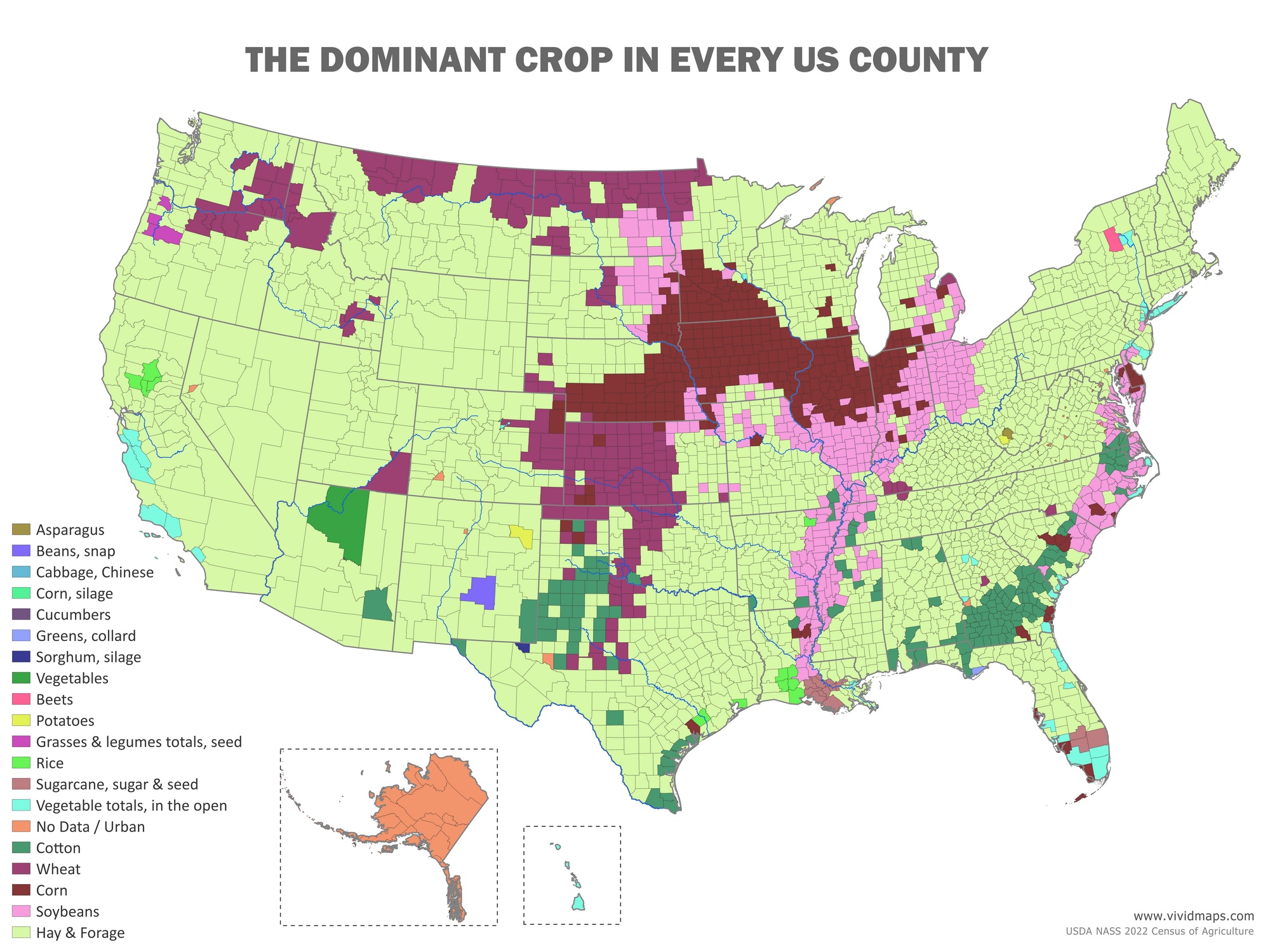
It is easy to think of US farming as mostly corn and soybeans. The country runs nearly two million farms across roughly 300 million harvested acres (about 121 million hectares) though, enough room for sugarcane in Louisiana, potatoes across southern Idaho, and rice in Arkansas alongside everything else. Using the 2022 USDA NASS Census of Agriculture, I mapped the dominant crop across all 2,968 continental US counties, comparing 22 crop categories by share of harvested cropland. Orchards aren’t included.
The pale green covering roughly half the map is hay and forage. Not corn. Not soybeans. Hay.
The US runs one of the world’s largest cattle and dairy industries, and those animals need feed all through winter when pasture is gone. That demand adds up fast across dozens of states. Drought hit Texas, Oklahoma, and Colorado particularly hard in 2022, which pushed the national dry hay harvest down to 49.5 million acres (about 20 million hectares), the lowest figure recorded since 1907. Texas still came out ahead of every other state at nearly 4.2 million acres (about 1.7 million hectares), despite being more than 25% below its 2021 total. Missouri put up 3.18 million acres (about 1.3 million hectares) and Oklahoma 3 million (about 1.2 million hectares) in what was a difficult year for much of the southern Plains.
The situation in Iowa, Illinois, Nebraska, and Indiana is different. That dark maroon block is corn, 79.2 million acres (about 32 million hectares) harvested for grain in 2022. Pink soybeans sit right alongside at roughly 86 million harvested acres (about 35 million hectares) the same year. These two rotate in the same fields season after season, which is why they share county borders so consistently across the map.
Most of those corn acres are not producing food for people. About 40% of domestic corn use goes to animal feed, with approximately 39% going to ethanol production. The portion reaching human food products is below 10%. 97% of domestic soybean meal goes into livestock and poultry feed as well. All three crops, hay, corn, and soybeans, are largely serving the same purpose at different stages of the same system. Most US cropland exists to feed animals, which then become the meat, dairy, and eggs on your plate.
Wheat grows across Kansas, stretches up through Montana and the Dakotas, and appears again in eastern Washington. West Texas goes dark green with cotton, which continues through the Mississippi Delta and into parts of the Southeast, while rice occupies counties along the Gulf Coast.
What draws the eye next is a small lilac cluster: the counties of the Willamette Valley in western Oregon. These counties supply virtually the entire US production of annual ryegrass, perennial ryegrass, bentgrass, and fine fescue across more than 400,000 statewide acres (about 162,000 hectares). The seed gets shipped to lawns, golf courses, and sports fields across the country and around the world. Linn County has carried the nickname Grass Seed Capital of the World since a farmer near the town of Tangent planted the first commercial ryegrass crop there in 1921. The grass under most American lawns, golf courses, and sports fields started its life there.
Crop
Primary Regions
Approx. Harvested Area (2022)
Primary End Use
Hay & Forage
Nationwide; strongest in Plains, Mountain West, South
~49.5M acres / ~20M ha (dry hay)*
Livestock feed
Soybeans
Iowa, Illinois, Minnesota, Indiana, Missouri
~86M acres / ~35M ha
Animal feed (~75% by weight), export, soybean oil
Corn
Iowa, Illinois, Nebraska, Indiana
~79.2M acres / ~32M ha (grain only)**
Animal feed (~40%), ethanol (~33%), human food (<10%)