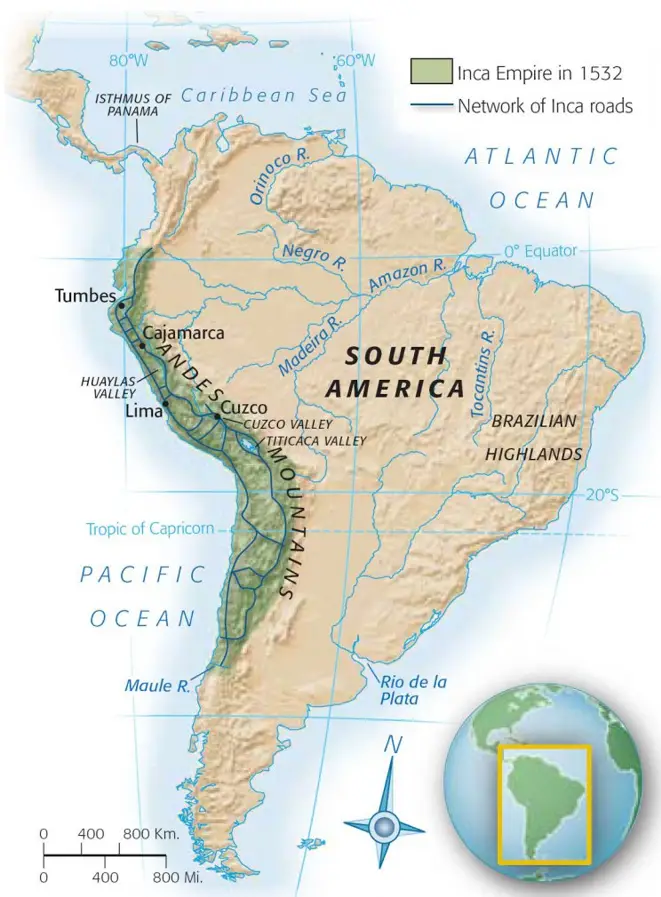
Roughly 21,000 years ago, people were already living near what is now the Reconquista River in Argentina. The Monte Verde site in southern Chile pushes confirmed settlement back to at least 14,800 years ago. By 1500, the Inca controlled the Andean spine, and hundreds of other cultures occupied everything from the Amazon basin to Patagonia.
That same year, Portuguese ships reached Brazil, and the Spanish were already pushing south from the Caribbean. Between 1492 and 1820, roughly 2.6 million Europeans emigrated to the Americas, with Spanish and Portuguese together accounting for around 40% of that flow.
Argentina and Brazil were actively recruiting European settlers by the mid-1800s. Between 1820 and 1960, roughly 16.8 million Europeans emigrated to Latin America. Italians led, with around 6.7 million, followed by Spanish at 5.4 million and Portuguese at 1.85 million. Argentina alone absorbed about 6.5 million European immigrants, Brazil around 4.5 – 5 million.
Country
Approx. European Ancestry
Uruguay
~77%
Argentina
~71%
Brazil
~62%
Paraguay
~60%
Venezuela
~56%
Chile
~54%
Colombia
~42%
Ecuador
~36%
Peru
~29%
Bolivia
~12–25%
Bolivia and Peru had large pre-Columbian populations that were preserved after colonization. That is why these countries now have the lowest percentage of people with European ancestry.
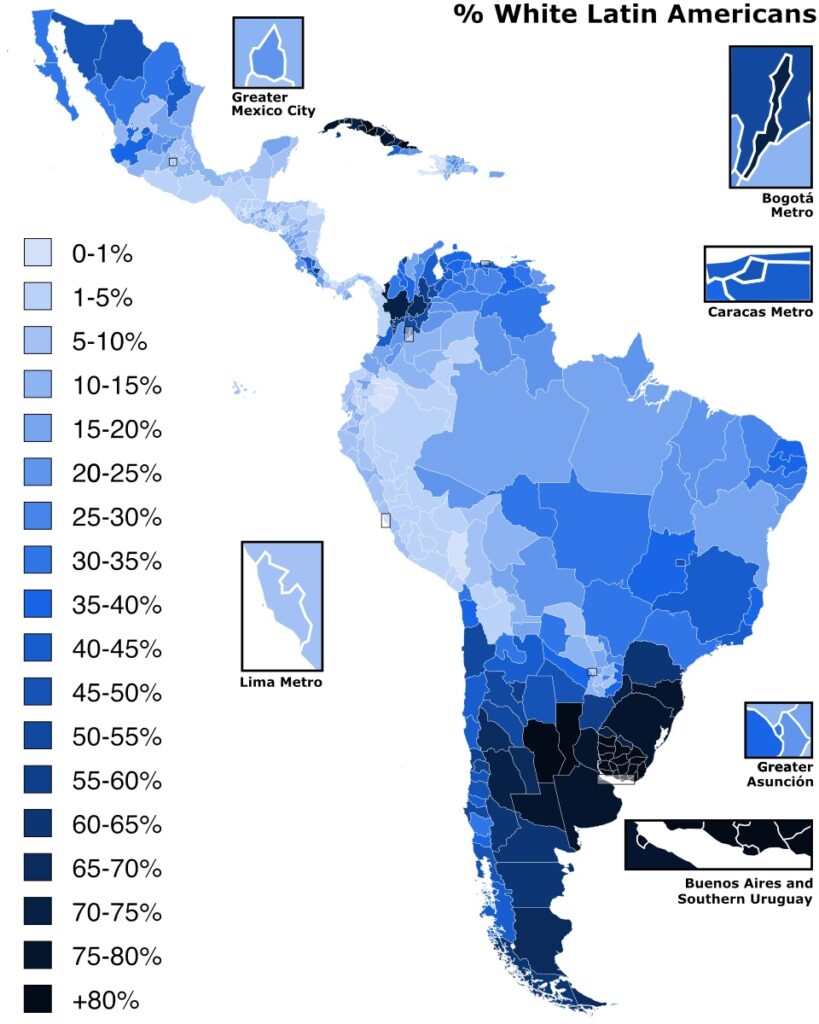
The map below shows the percentage of Latin Americans who self-identify as white.
Uruguay has the highest proportion of self-identified white Latin Americans in the region, which tracks with its ~77% European genetic ancestry.
Interestingly, German settlers arrived in the Serra Gaúcha highlands from 1824 and introduced early agriculture, but the commercial wine industry there is overwhelmingly the legacy of Italian immigrants who came after 1875 and settled the higher elevations around Bento Gonçalves and Garibaldi. That region is now Brazil’s main wine-producing area. Those same Italian communities were so geographically cut off for so long that they grew a language no longer spoken anywhere in Europe. Talian blends old Venetian with Portuguese and is still heard in villages around Caxias do Sul and Bento Gonçalves today, spoken by an estimated 500,000 people. Rio Grande do Sul and Santa Catarina recognized it as historical heritage in 2009, and IPHAN added it to Brazil’s national cultural heritage inventory in 2014.
In Buenos Aires, fainá has been considered simply Argentine food for so long that most people eating it alongside pizza on a Friday night have no idea it’s a Genoese chickpea flatbread that crossed the Atlantic in the 1800s. Italian is still the country’s third most spoken language with over 1.5 million speakers.