
Alligator Range Map in the United States
Most people assume Florida is the alligator capital of America. That makes sense, given the airport runway videos, the swimming pool surprises, and the University of Florida’s rather apt mascot. But pull up the population data, and Louisiana beats it by a wide margin, with over 2 million wild alligators, according to the Louisiana Department of Wildlife and Fisheries.
American alligators (Alligator mississippiensis) are native to the southeastern United States and, alongside their much rarer relative the Chinese alligator (Alligator sinensis), are the only two surviving members of the genus Alligator. Adult males typically measure between 3.4 and 4.8 meters (11.2 to 15.7 feet) and can weigh up to 900 kg (around 2,000 pounds) in exceptional cases, making them the largest reptile in North America. Females are considerably smaller, usually between 2.6 and 3.35 meters long.
Their conservation history is one of the more remarkable turnarounds in American wildlife management. Unregulated hunting for their hides had pushed populations to the brink by the mid-20th century, and in 1967 the species was listed under the precursor to the Endangered Species Act. By 1987, the American alligator had recovered enough that the U.S. Fish and Wildlife Service removed it from the endangered list. Today, the IUCN lists the species as Least Concern.
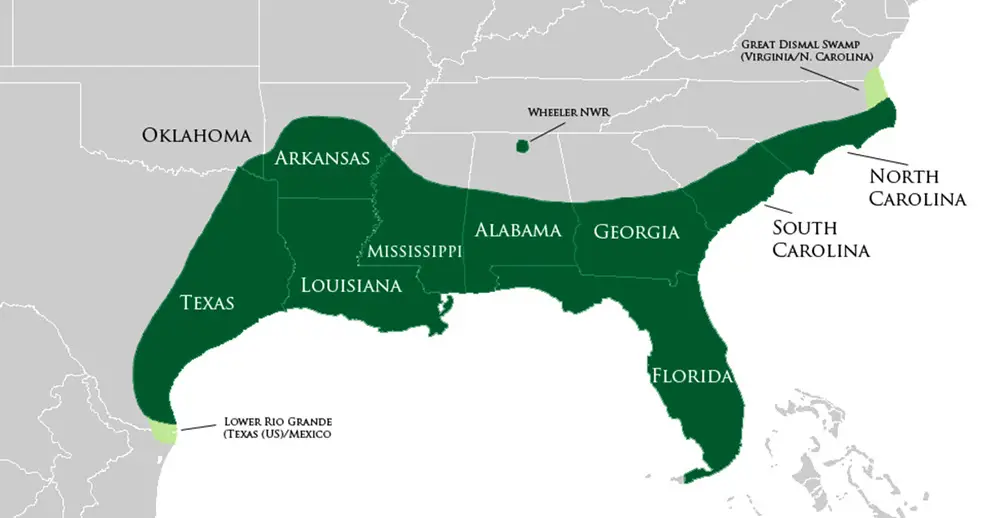
Louisiana has the largest American alligator population of any U.S. state. The map below shows the gator population by U.S state.
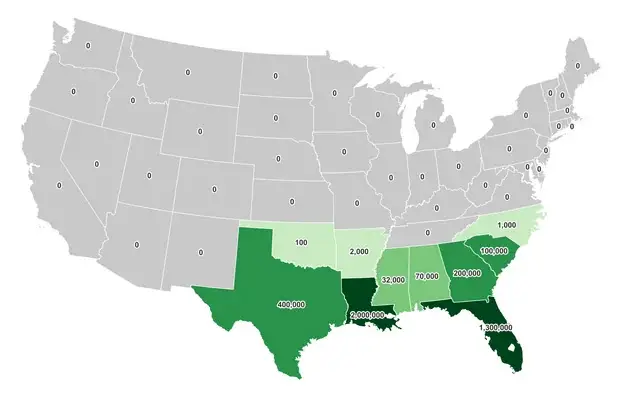
So where exactly do all these gators live? Only 10 U.S. states have established wild alligator populations, all in the Southeast, where warm temperatures and abundant wetland habitat make conditions nearly ideal. Wildlife Informer The table below breaks down the estimated wild populations by state.
[TABLE PLACEMENT: Insert the reference table here]
| State | Estimated Wild Population | Rank |
|---|---|---|
| Louisiana | 2,000,000+ | 1 |
| Florida | ~1,300,000 | 2 |
| Texas | 400,000-500,000 | 3 |
| Georgia | ~200,000 | 4 |
| South Carolina | ~100,000 | 5 |
| Alabama | ~70,000 | 6 |
| Mississippi | 32,000-50,000 | 7 |
| Arkansas | 2,000-3,000 | 8 |
| Oklahoma | small, localized | 9 |
| North Carolina | ~1,000 | 10 |
| Total (U.S.) | ~4.1-4.3 million |
Louisiana’s massive swamplands and warm climate make it a near-perfect environment for alligators, and the state is also famous for alligator farming, with an additional 1 million gators kept on farms there. Florida’s 1.3 million alligators are spread across the state, and almost any standing body of fresh water could host one. Texas rounds out the top three, with an estimated 400,000 to 500,000 gators concentrated in nearly half of the state’s 254 counties, along the Gulf Coast and near the Rio Grande.
One thing that genuinely sets Florida apart from every other state on this map is that Florida is the only place in the world where both alligators and American crocodiles coexist naturally in the wild. That alone makes it ecologically extraordinary.
Beyond being impressive predators, alligators serve a function that few other animals can. They modify wetland habitats by constructing small ponds known as alligator holes, which retain water during dry seasons and provide refuge for fish, birds, and other aquatic organisms. This behavior has qualified the American alligator as a keystone species.
Their range is also slowly shifting northward as temperatures change, with alligators now naturally expanding into areas like Tennessee where they were previously not viable. Whether that continues to accelerate will depend on how much the climate shifts in coming decades, which makes this map one that may look a little different in 30 or 40 years.
For now, the southeastern United States remains their stronghold, and Louisiana, for all its famous bayou country, deserves more credit than it usually gets for hosting one of the most successful wildlife recoveries in U.S. history.
To learn more about alligators and crocodiles, consider checking out the following books.
- Alligators and Crocodiles
- Alligators: The Illustrated Guide to Their Biology, Behavior, and Conservation


Handbags and boots waiting to be made…
We bought ourselves a little portion of swamp (excuse me – wetlands) in Florida, north of Tampa, about 16 months ago. We have also have a huge pond on our property, with the east edge being approximately 8′ from the driveway. We’ve always heard the juniors chirping in the near distance, but this is the 1st time we’ve seen anything. I walked out on the porch this morning to get grab a package and was greeted with 3 very large/loud growls. By the time i slipped on my shoes and went back out, it (probably she) was in the center of the pond. Given the measure of approximately 9-10″ from between the eyes to between the nostrils, she would be about 9′ or so long. Not sure if we can have her relocated since it would just be across the west side of the pond – we moved into her land . . .
Thanks for sharing your experience—what a vivid encounter! It sounds like you’ve got a real slice of wild Florida right in your backyard. That size estimate puts her at a pretty impressive length, and those growls are a classic territorial warning, especially if she’s nesting nearby. You’re absolutely right—alligators were there first, and it’s their habitat too. If you ever feel unsafe, Florida Fish and Wildlife can assess the situation and determine if relocation is necessary. But it’s also incredible to be able to observe such a powerful animal so closely (from a safe distance, of course!). Keep an eye (and an ear) out—sounds like you’ve got quite the wild neighbors.