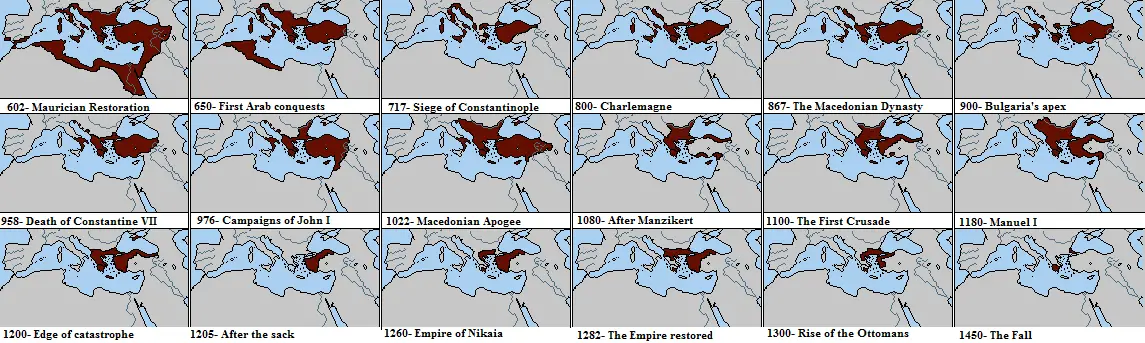
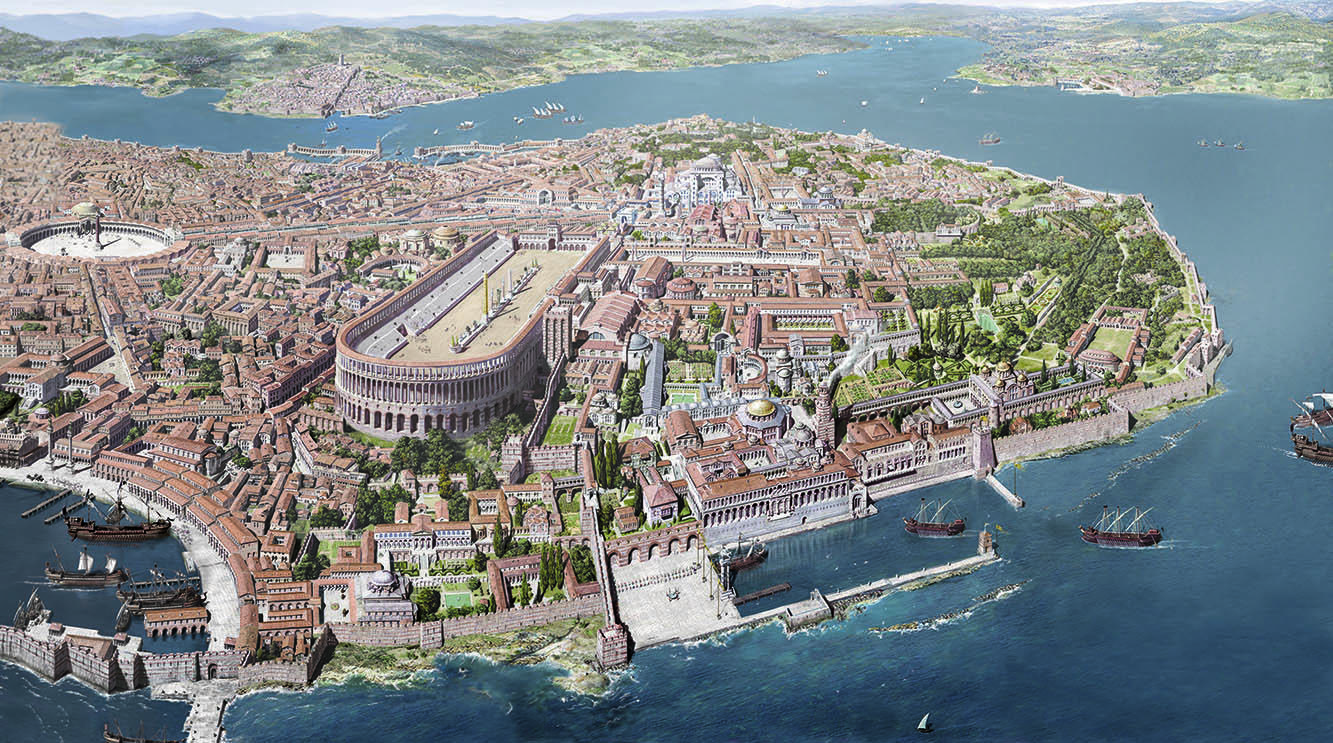
Basil II died on December 15, 1025, with an expedition to recover Sicily still in preparation. The empire he left behind reached from southern Italy to the Caucasus and from the Danube to the Levant. Its territory had not been that large since the Muslim conquests, four centuries earlier.
The Byzantine Empire in 1025 spanned southern Italy, the Balkans up to the Danube, and lands from the Caucasus to the Levant, all governed from Constantinople under Basil II. He had held the throne for nearly 50 years, the longest reign of any Roman emperor, and his treasury contained 14.4 million nomismata.
Key takeaways
Basil II reigned for 49 years and 11 months, the longest of any Roman emperor.
Bulgaria submitted in 1018, four years after the Battle of Kleidion.
The Danube became a Byzantine frontier again for the first time in about 400 years.
The treasury held 14.4 million nomismata at his death, roughly two years of imperial revenue.
Who ruled the Byzantine Empire in 1025?
Basil II, born in Constantinople in 958, was crowned co-emperor on April 22, 960, at about age two. Two generals, Nikephoros Phokas and John Tzimiskes, held the senior throne from 963 to 976. Basil took it on January 10, 976, though his great-uncle Basil Lekapenos kept control of the court until 985.
Rebellion came next. The Anatolian generals Bardas Skleros and Bardas Phokas both rose against him, and the fighting ended around 989, after Phokas died in battle and Skleros surrendered. To win, Basil accepted 6,000 soldiers from Vladimir I of Kiev, who asked for Basil’s sister Anna as his bride. Those Rus’ troops became the Varangian Guard.
Basil never married and had no children. His brother Constantine VIII, co-emperor since 962 or 963, inherited the throne in 1025.
How did Basil II conquer Bulgaria?
The decisive phase lasted from 1000 to 1018. It started badly for him. In 986 Basil lifted the siege of Sofia and was ambushed at the Gates of Trajan, escaping with help from the Varangian Guard.
The decisive blow landed on July 29, 1014 at Kleidion. Basil and his general Nikephoros Xiphias outmaneuvered the Bulgarian army guarding a mountain pass. Later accounts say 15,000 prisoners were taken and 99 of every 100 were blinded, a scale that may be exaggerated. Tsar Samuel died on October 6, 1014. Bulgaria submitted in 1018 and Basil marched into Sofia.
The nickname Bulgar Slayer is younger than the man. Historians place its common use around the end of the 12th century. Greeks regard Basil as a national hero, while among Bulgarians he remains a despised figure.
What territory did the Byzantine Empire hold in 1025?
Most of the late additions date to 1018 through 1022. Earlier gains, such as the lands inherited from David of Tao in 1001, filled in the eastern frontier.
Territory
Year
How it joined the empire
Bulgaria
1018
Last resistance ended four years after Kleidion. Organized as the theme of Bulgaria.
Croatia
After 1018
Rulers Krešimir III and Gojslav accepted Basil’s supremacy. Croatia stayed a tributary state until 1025.
Tao, Phasiane and Speri
1001
Inherited after the death of David of Tao and organized as the theme of Iberia.
Vaspurakan
1021
King Seneqerim-John ceded his kingdom in exchange for estates in Sebasteia.
Georgian border districts (Tao, Phasiane, Kola, Artaan, Javakheti)
1022
Handed over by treaty after the Battle of Svindax.
Southern Crimea
After 1016
Occupied following a joint campaign with Mstislav of Chernigov.
Southern Italy
976 to 1025
Recovered much of the land lost over the previous 150 years.
Armenian sub-kingdoms
Before 1025
Annexed. King Hovhannes-Smbat also promised that Ani and its surrounding regions would pass to Byzantium after his death.
How rich and powerful was the empire under Basil II?
Basil lowered taxes for small farmers. In 1002 he ordered wealthy landholders to cover the unpaid taxes of poorer neighbors. He ate the same daily rations as his soldiers. Historian John Julius Norwich wrote that Basil “cared only for the greatness of his Empire”.
Measure
Figure
Length of reign
49 years and 11 months
Annual revenue
7 million nomismata
Treasury at death
14.4 million nomismata
Army
Up to 110,000 men
Population
About 12 million
What happened to the empire after 1025?
Prosperity lasted for decades. The great landowning families still took back the government after Basil’s death. Then came 1071. The Normans permanently pushed the Byzantines out of southern Italy in April, and the civil strife that followed the defeat at Manzikert left the Anatolian frontier open to the Seljuks.
Where can you read more about Byzantium?
Two books for readers who want the wider picture (Amazon affiliate links).