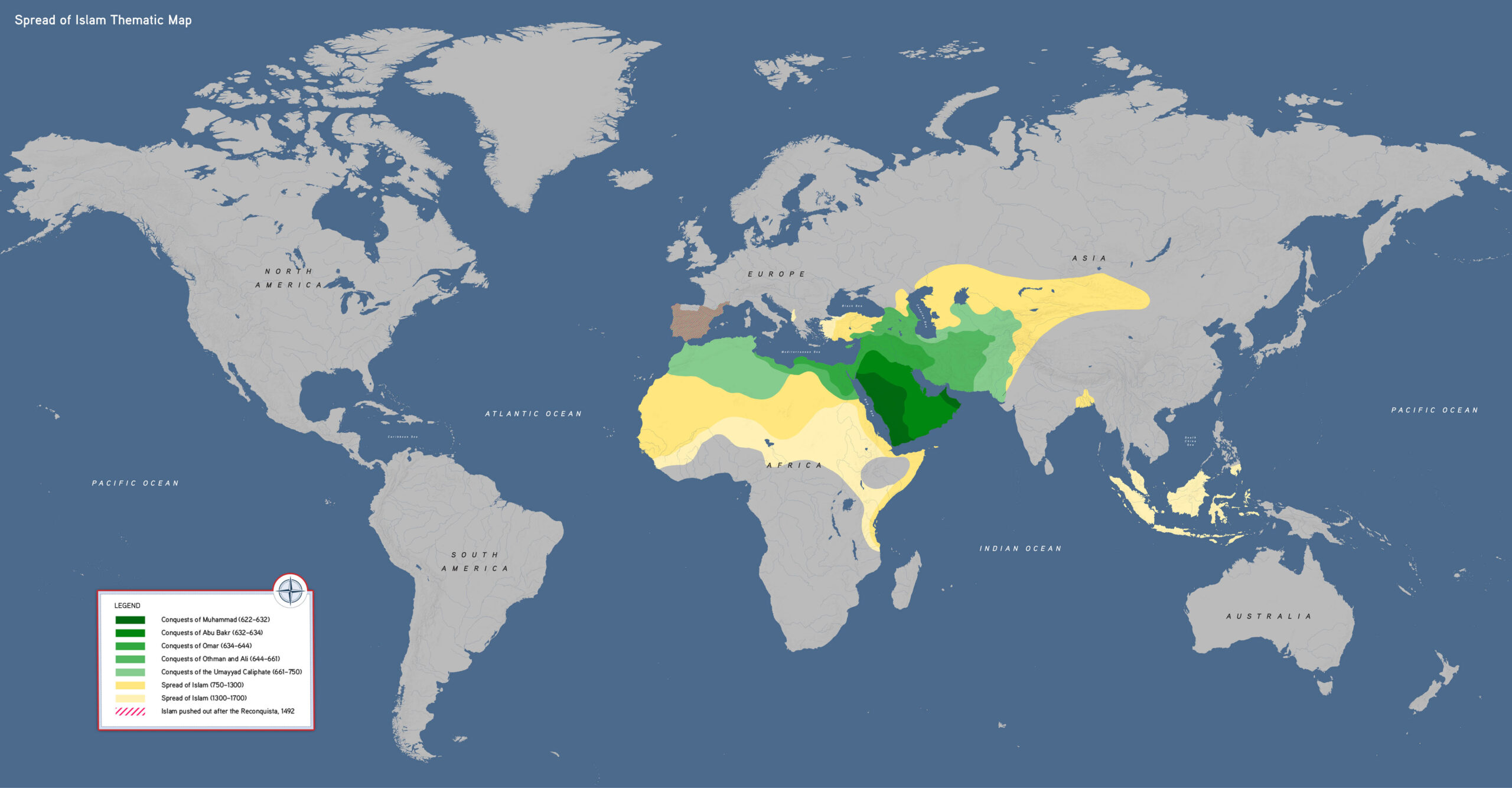
Islam began in the early 7th century CE and now has almost 2 billion followers. But what if Islam had never existed? How might the religious landscape of the Middle East, North Africa, and Central Asia be different?
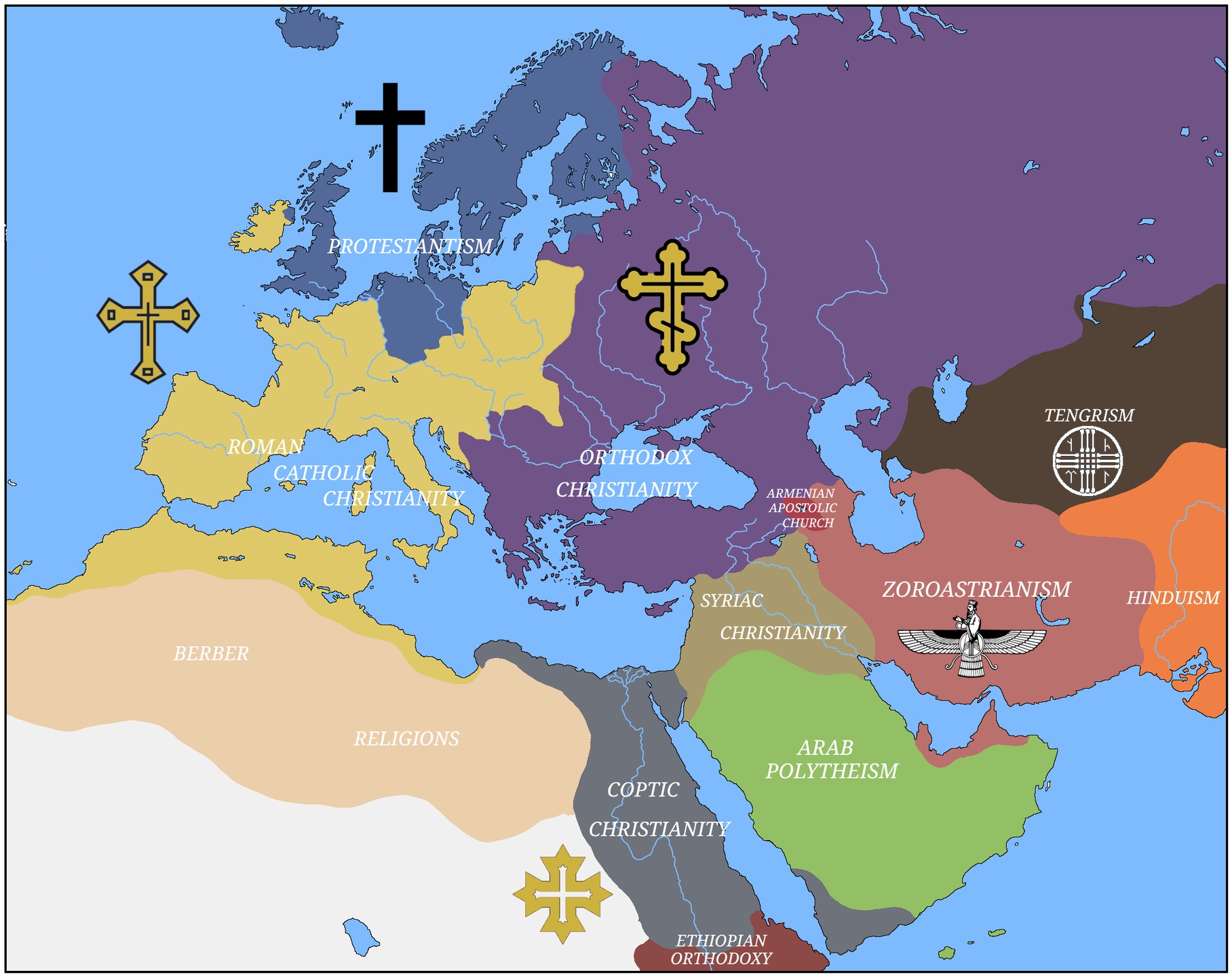
The Arabian Peninsula before Islam was mostly polytheist. The Kaaba in Mecca was already a major pilgrimage site, but at the time it housed around 360 idols, one for each tribal deity, with Hubal at the center. Judaism and Christianity had both reached parts of Arabia, mostly in areas that bordered the Byzantine and Sassanid empires, but neither had any real hold over the interior.
In Persia Zoroastrianism had been the official faith of the Sassanid Empire for over four centuries when Arab armies defeated the Sassanids between 633 and 651 CE. Many Zoroastrians left for India rather than convert, and their descendants, the Parsis, are still there. There are now around 100-200 thousand Zoroastrians worldwide, a small number for a religion that was once the state faith of one of antiquity’s major empires.
Augustine of Hippo was from what is now northeastern Algeria. Tertullian, who coined the word “Trinity,” was from Carthage in modern Tunisia. They’re two of the most influential figures in Christian history, and both came from a region that’s now almost entirely Muslim. By the 5th century, North Africa was a major center of Christian life. The Arab conquests changed that over the following centuries, and by around the 11th century the last indigenous Christian communities in the Maghreb were gone.
In Egypt, the Coptic Church survived the Arab conquest of 641 CE and is still there, now counting around 12 million members, about 10% of the country’s population.
Before the Arab conquests, the Syriac Church had missionary networks reaching as far as China. In 635 CE, a Syriac monk named Alopen arrived in Chang’an and was received by Emperor Taizong, who invited the Christians to translate their sacred works for the imperial library. The real pressure on Syriac communities came from the 8th century onward (during the reign of ‘Abd al-Malik) rather than immediately after the Arab conquests, and over time those communities contracted significantly. Around 1.5 million people identify with Syriac Christianity today.
Religion
Approximate Date of Origin
Current Followers (approx.)
Roman Catholic Christianity
1st century CE; distinct from Eastern church after 1054 CE
~1.42 billion
Protestantism
1517 CE (Luther’s Reformation)
~900 million
Eastern Orthodox Christianity
1st century CE; formal split from Rome 1054 CE
~240-300 million
Armenian Apostolic Church
1st century CE; state religion of Armenia from 301 CE
~9 million
Coptic Christianity
1st century CE (traditionally founded by St. Mark, c. 42 CE)
~15-18 million worldwide
Syriac Christianity
1st century CE (Antioch, c. 37 CE)
~1.5 million
Ethiopian Orthodoxy
4th century CE (Christianization of Aksum, c. 330 CE)
~60 million worldwide
Arab Polytheism
Ancient; dominant until 630 CE
Extinct
Zoroastrianism
c. 6th century BCE; state religion of Persia until 651 CE
~150 thousand
Berber Religions
Ancient; indigenous pre-Islamic traditions
Extinct
Hinduism
c. 2000-1500 BCE
~1.2 billion
Tengrism
c. 2000-1000 BCE
Ancient Central Asian belief; seeing a modern minor revival in parts of Central Asia.
Roman Catholicism, Orthodox Christianity, and Hinduism were all established long before the 7th century, and the Arab conquests didn’t substantially reach their heartlands. Arab forces never made it to the Horn of Africa either, which is why the Ethiopian Orthodox Church survived intact and today counts around 60 million followers worldwide. Tracking Tengrism is more challenging because the shamanistic traditions of the steppe peoples largely converted to Islam in the 14th century, though slowly enough that many practices got folded into local Islamic customs rather than disappearing outright. Without Islam, it would likely still span much of Central Asia.
The Arab conquests of the 7th and 8th centuries changed a lot of what you see on this map. Some religious communities survived them, like the Coptic Church. Most didn’t, at least not in any recognizable form. Arab polytheism is effectively gone. Zoroastrianism went from being the state religion of one of the ancient world’s major empires to having around 150 thousand adherents worldwide. North African Christianity simply vanished.