Between the U.S. and Canada, we’re raising about 98 million cattle. The U.S. has roughly 87 million, Canada another 12 million. That’s a lot of beef heading to supermarkets, restaurants, and export ships bound for Asia and Europe.
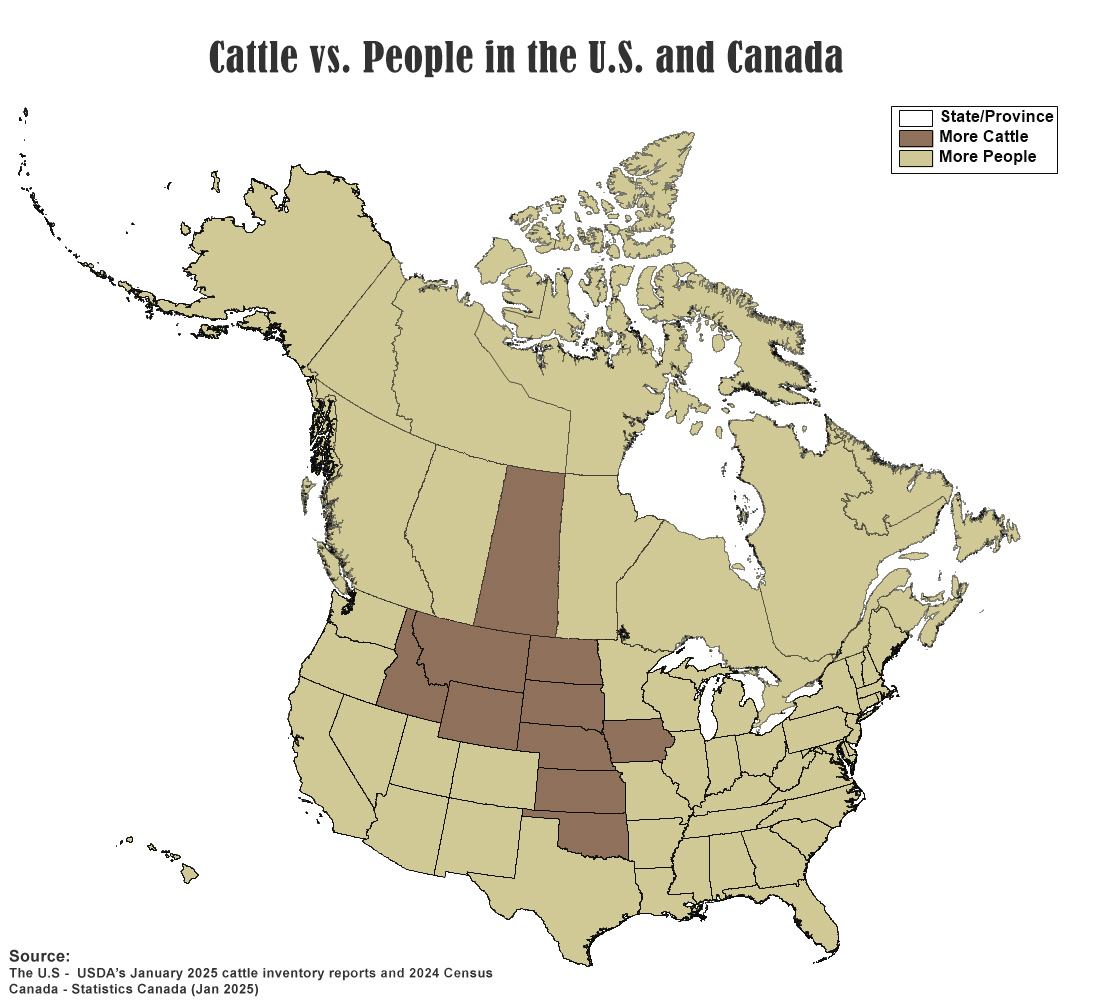
But when you map where all those cattle actually live, the distribution looks nothing like the human population map. In fact, ten states and one province have flipped the script entirely—more cattle than people.
South Dakota leads the pack at 3.5 million cattle versus 924,000 people. That’s nearly four cows for every resident. Nebraska takes it further with 6 million cattle and only 2 million people.
State / Province
Cattle (head)
Humans
Cattle as % of People
Idaho (US)
2,490,000
2,001,619
124%
Montana (US)
2,160,000
1,137,233
190%
Wyoming (US)
1,220,000
587,618
208%
North Dakota (US)
1,680,000
796,568
211%
South Dakota (US)
3,550,000
924,669
384%
Nebraska (US)
6,050,000
2,005,465
302%
Kansas (US)
5,950,000
2,970,606
200%
Iowa (US)
3,500,000
3,241,488
108%
Oklahoma (US)
4,600,000
4,095,393
112%
Saskatchewan (Canada)
2,095,000
~1,190,000
176%
Alberta just misses the cut at 96%. They’ve got 4.7 million cattle and 4.9 million people, so one good year could push them over. Manitoba sits at 61% because Winnipeg adds over 700,000 people to the provincial count, even though the countryside has plenty of cattle.
Look at where these places cluster. Montana and Wyoming in the west, the Dakotas in the north, Nebraska and Kansas in the center, Iowa and Oklahoma on the edges, then Saskatchewan up in Canada. It’s the Great Plains and the southern edge of the Prairie Provinces.
Why here? The semi-arid grassland gets 10 to 15 inches of rain each year. That is enough for native grasses to grow, but it is not enough for crops unless there is irrigation.
Meanwhile, the human population has been dropping since the 1950s. Small towns lose their high school graduates every June. Those kids go to college in Lincoln or Wichita or Regina, and most never come back. Main Streets empty out. Schools close. But ranching operations got bigger and more efficient. Better equipment, better breeding, better feed management. A ranch that needed five workers 40 years ago might need two now, even with twice as many cattle.