Around 21,000 years ago, you could walk from Britain to the continent without crossing water. The North Sea floor was dry land. A broad plain linked Siberia to Alaska, which is partly how mammoths and eventually humans made it between Asia and the Americas at all. Sea level was approximately 125 meters lower than it is today, as a significant amount of water was locked up in ice sheets across the Northern Hemisphere.
This was the Last Glacial Maximum. The period spans roughly 26,500 to 19,000 years ago, with peak ice extent around 21,000 years BP. The Laurentide sheet covered most of Canada and pushed well into what is now the northern United States. In Europe the Fennoscandian sheet buried all of Scandinavia and most of Britain, with its southern edge running through what is now northern Germany and Poland. CO₂ in the atmosphere was about 180 parts per million, compared to 280 ppm before industrialization and over 420 ppm today. The air was also dramatically dustier than it is now: ice cores show concentrations 20 to 25 times higher than modern levels, blown off bare, vegetation-poor land by strong persistent winds.
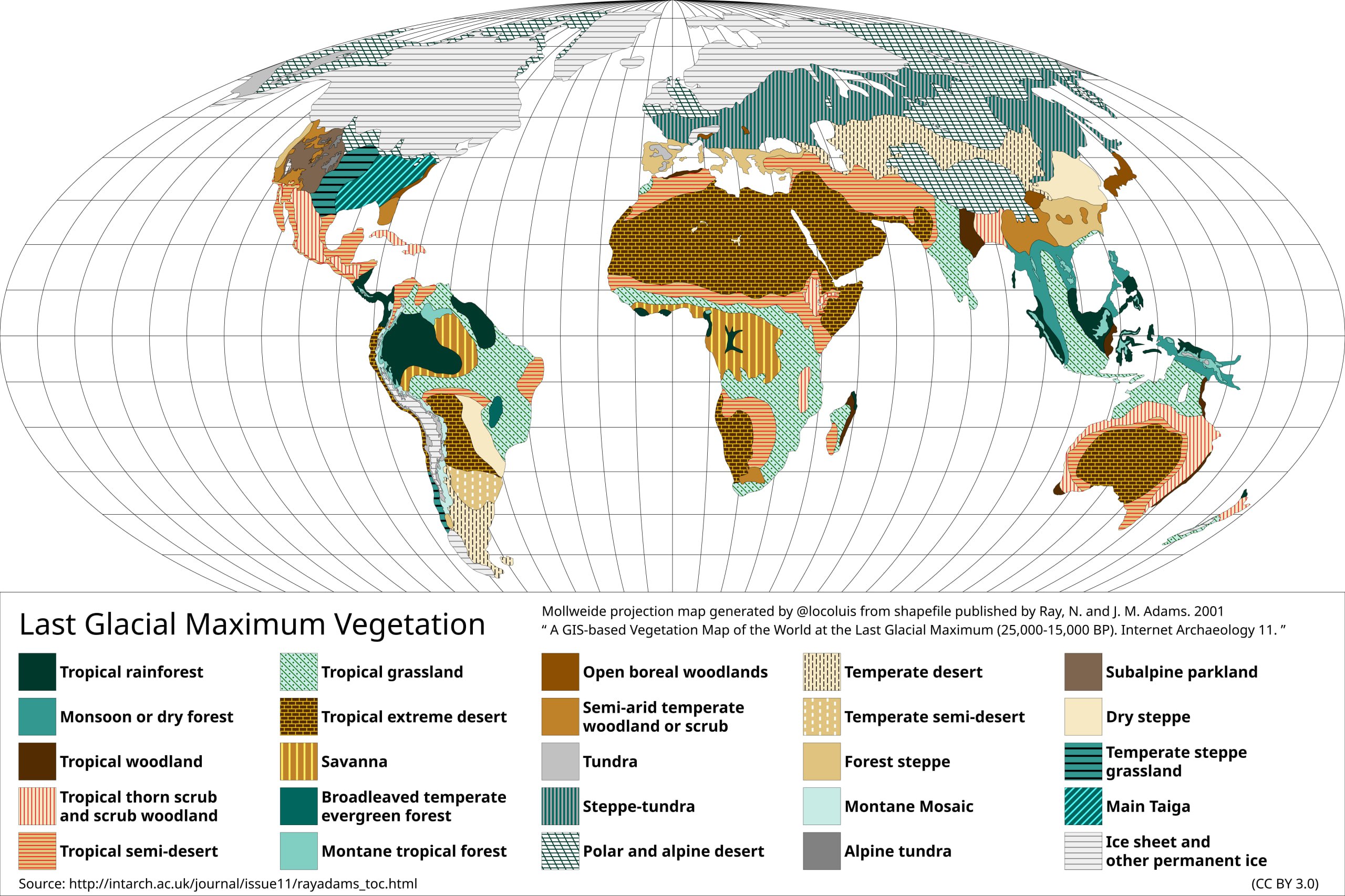
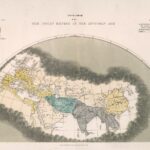
The map below was made by @locoluis from the paleoclimate vegetation shapefile published by Nicolas Ray and Jonathan Adams in 2001. It covers the broad window of roughly 25,000 to 15,000 years before present.
Last Glacial Maximum vegetation
The white areas with gray horizontal stripes on the world map above are ice sheets. Just south of the European ice comes polar and alpine desert — the zone covering the area where London is now located. Paris sits in the Steppe-tundra. Berlin is right at the ice margin.
In North America, open boreal woodland covered the Atlantic seaboard where temperate deciduous forest now stands. The interior of the continent was temperate steppe-grassland. The northern Pacific coast held forest steppe, while further south, across what is now California and the American Southwest, the reconstruction shows semi-arid temperate woodland and scrub.
In what is now the Amazon basin, the reconstruction shows two separate fragments of tropical rainforest, with tropical grassland and savanna between them. West African rainforests retreated into scattered patches, surrounded by tropical grassland. While the Sahara shows up as a tropical extreme desert. Australia’s interior, according to Ray and Adams climate reconstruction as tropical thorn scrub and scrub woodland, with tropical extreme desert across a significant area.
How cold was it?
The answer is that it depends on which study you consult, and the estimates have shifted as methods improved. A 2022 reconstruction by Annan, Hargreaves and Mauritsen in Climate of the Past puts global mean cooling at about 4.5°C below pre-industrial temperatures. Tierney et al. in Nature (2020) arrived closer to 6.1°C. Both teams combined climate model simulations with proxy records through data assimilation, and both are methodologically credible. The gap between their numbers comes mostly from differences in which model simulations they used as a starting point.
City
Modern Annual Avg
LGM Estimated Annual Avg
LGM Climate Type
New York, USA
13°C (55°F)
0 to −5°C (32 to 23°F)
Ice sheet margin / periglacial tundra
London, UK
11°C (52°F)
−1 to −4°C (30 to 25°F)
Polar and alpine desert / tundra
Paris, France
12°C (54°F)
0 to 2°C (32 to 36°F)
Polar and alpine desert / tundra
Berlin, Germany
10°C (50°F)
−3 to −5°C (27 to 23°F)
At ice margin / periglacial polar desert
Moscow, Russia
6°C (43°F)
−10 to −12°C (14 to 10°F)
Deep permafrost / polar desert-tundra
Beijing, China
13°C (55°F)
3 to 5°C (37 to 41°F)
Cold steppe / grassland-tundra mosaic
Tokyo, Japan
16°C (61°F)
8 to 10°C (46 to 50°F)
Temperate steppe / open woodland
Cairo, Egypt
22°C (72°F)
17 to 18°C (63 to 64°F)
Tropical extreme desert
Mumbai, India
27°C (81°F)
22 to 24 °C (72 to 75°F)
Drier tropical scrub
São Paulo, Brazil
20°C (68°F)
15 to 16°C (59 to 61°F)
Savanna / dry forest
Sydney, Australia
18°C (64°F)
14 to 16°C (57 to 61°F)
Semi-arid grassland / scrub
Mexico City, Mexico
15°C (59°F)
9 to 10°C (48 to 50°F)
Montane scrub / cooler savanna
According to Seltzer et al., low-altitude land between about 45°S and 35°N cooled by 5.8 ± 0.6°C on average. At higher latitudes the numbers were considerably larger. Groundwater from an aquifer under the Paris basin points to local cooling of around 9°C relative to the Holocene.
What happened to biodiversity when the Ice Age ended?
From about 19,000 years ago, the warming picked up fast enough to transform the landscape. Grassland became forest. Bogs crept across country that had been open for millennia. For the large grazers this was a different kind of problem than cold had ever been — there simply wasn’t enough of the right ground left. By about 11,700 years ago roughly 64% of megafaunal genera were gone worldwide. North America lost 38 genera of mostly large mammals. Habitat loss was part of it, but when you look at where and when the losses happened across different continents, they follow human expansion more closely than any temperature curve.
Some animals had no trouble with any of it. Brown bears and wolves are at home in forest, so the change in vegetation barely registered for them. Musk oxen and reindeer kept going in whatever open ground was left. Wild boar, red deer, saiga antelopes, Arctic foxes — all pulled through. Horses did fine across Eurasia but had disappeared from the Americas by about 10,000 years ago. Smaller animals and birds shifted their ranges as the vegetation moved and mostly got on with it.
Oak, beech, and lime had been sitting out the cold in scattered refugia across Iberia, the Balkans, and the Caucasus — far enough south to stay viable. They didn’t rush back north. It took thousands of years, and the genetic record of that gradual recolonization is still there in European forests.
First of all, congratulations for this great job. It is a really interesting post and very well documented.
I guess that the average temperature of Bombai at that time is wrong, though.






First of all, congratulations for this great job. It is a really interesting post and very well documented.
I guess that the average temperature of Bombai at that time is wrong, though.
Scientists say Mumbai was 3–5 degrees cooler during the Ice Age. Since it’s about 27°C now, it must have been around 22°C back then.