For thousands of years, humans mostly lived in small groups. A village of 200 people was ordinary. Getting 1,000 people together in one place was remarkable. Then cities happened and changed everything about how we live.
Here’s the thing about cities versus villages. In a village, everyone’s involved in getting food somehow. Either you farm or you help the farmers or you’re related to farmers. Cities work completely differently. You’ve got potters who never grow grain. Weavers who don’t raise animals. Scribes who just write things down all day. Soldiers. Priests. Merchants. All these people eating food they didn’t produce.
So you need farmers somewhere else growing extra. You need that food transported in. You need clean water coming from somewhere and dirty water going somewhere else. You need people organizing all of this or it falls apart fast.
Around 3000 BCE, Uruk in what’s now southern Iraq hit 40,000 people. Nobody had managed anything close to that before. Archaeologists dug up thousands of clay tablets there. Bureaucrats tracking everything. How much barley goes to the temple workers. How much beer for the priests. Who gets textiles. Who owes what. Running a city of 40,000 took serious organization.
Why does it matter which city was biggest? Because size follows power and money. The largest city shows you where the empire was strongest, where trade routes met, where the wealth piled up. When a big city’s population crashes, something went wrong. Plague. Invasion. Famine. Economic collapse. When it grows, opportunity is expanding.
Here’s how the rankings changed over time.
3000-2000 BCE: Mesopotamia and Egypt
Rank
3000 BCE
Population
Modern Country
1
Uruk
20,000
Iraq 🇮🇶
2
Memphis
20,000
Egypt 🇪🇬
3
Tell Brak
20,000
Syria 🇸🇾
4
Shahr-e Suktech
15,000
Iran 🇮🇷
5
Anshan
10,000
Iran 🇮🇷
Rank
2300 BCE
Population
Modern Country
1
Mohenjo-daro
40,000
Pakistan 🇵🇰
2
Akkad
36,000
Iraq 🇮🇶
3
Memphis
32,000
Egypt 🇪🇬
4
Ebla
30,000
Syria 🇸🇾
5
Umma
20,000
Iraq 🇮🇶
For close to two thousand years, the biggest cities were clustered in Mesopotamia and Egypt. Makes sense when you think about it. The Tigris, Euphrates, and Nile meant reliable water and good farmland. Surplus grain supported city populations. Plus trade networks brought in copper from Anatolia, lapis lazuli from Afghanistan, timber from Lebanon. Cities need more than just local resources to thrive.
1200 BCE: Breaking 100,000
Rank
1200 BCE
Population
Modern Country
1
Pi-Ramesses
160,000
Egypt 🇪🇬
2
Yin
85,000
China 🇨🇳
3
Babylon
80,000
Iraq 🇮🇶
4
Thebes
80,000
Egypt 🇪🇬
5
Ashur
30,000
Iraq 🇮🇶
Ramesses II built Pi-Ramesses in the Nile Delta as his military headquarters. First city to break 100,000 people. Meanwhile over in China, Yin was getting close to the same size. Think about that. Two huge cities on opposite ends of the world, both managing populations that would’ve seemed crazy a few centuries earlier.
700-200 BCE: From Nineveh to Alexandria
Rank
700 BCE
Population
Modern Country
1
Nineveh
100,000
Iraq 🇮🇶
2
Luoyang
100,000
China 🇨🇳
3
Linzi
55,000
China 🇨🇳
4
Babylon
45,000
Iraq 🇮🇶
5
Rome
40,000
Italy 🇮🇹
Nineveh, the Assyrian capital, was top dog for a while. Rome shows up at number five. Still pretty small compared to the eastern cities but growing steadily.
Rank
200 BCE
Population
Modern Country
1
Alexandria
600,000
Egypt 🇪🇬
2
Pataliputra
350,000
India 🇮🇳
3
Seleucia
300,000
Iraq 🇮🇶
4
Xiangyang
250,000
China 🇨🇳
5
Rome
250,000
Italy 🇮🇹
Alexandria shot up after Alexander the Great founded it where the Nile hits the Mediterranean. The famous library, the lighthouse, all that. But really it was about location. The city sat right where Mediterranean trade met Indian Ocean trade. Everything flowed through there. Rome’s up to fifth now, tied with Xiangyang.
100 CE: Rome Hits a Million
Rank
100 CE
Population
Modern Country
1
Rome
1,000,000
Italy 🇮🇹
2
Alexandria
423,000
Egypt 🇪🇬
3
Luoyang
420,000
China 🇨🇳
4
Chang’an
150,000
China 🇨🇳
5
Seleucia
258,000
Iraq 🇮🇶
Rome crossed one million. Some historians think maybe Chang’an or Alexandria got there first, but Rome definitely hit it. How? Grain ships from North Africa. Silver mines in Spain. Multiple aqueducts bringing in water from miles away. The city ate more grain in a year than medieval London would!
Didn’t last though. By 300 CE, Rome was down to 800,000. By 400 CE, only 500,000 left. Wars, disease, political chaos. People fled.
500-700 CE: China Takes the Lead
Rank
500 CE
Population
Modern Country
1
Nanjing
600,000
China 🇨🇳
2
Luoyang
500,000
China 🇨🇳
3
Ctesiphon
467,000
Iraq 🇮🇶
4
Constantinople
450,000
Turkey 🇹🇷
5
Pataliputra
300,000
India 🇮🇳
While Rome was shrinking, Chinese and Persian cities were growing. Ctesiphon (the Sasanian capital, near modern Baghdad) controlled the east-west trade routes. Constantinople was sucking up resources from what was left of the Roman Empire.
Rank
700 CE
Population
Modern Country
1
Chang’an
1,200,000
China 🇨🇳
2
Luoyang
498,000
China 🇨🇳
3
Guangzhou
200,000
China 🇨🇳
4
Constantinople
150,000
Turkey 🇹🇷
5
Kannauj
120,000
India 🇮🇳
Chang’an under the Tang dynasty got massive. The city had this organized grid layout with wide streets. Different districts for merchants, government people, foreigners. This design influenced how cities got built across East Asia for a long time after.
900-1000 CE: Baghdad Gets Huge
Rank
900 CE
Population
Modern Country
1
Baghdad
714,000
Iraq 🇮🇶
2
Luoyang
300,000
China 🇨🇳
3
Constantinople
300,000
Turkey 🇹🇷
4
Cordoba
175,000
Spain 🇪🇸
5
Kyoto
200,000
Japan 🇯🇵
Rank
1000 CE
Population
Modern Country
1
Baghdad
1,388,000
Iraq 🇮🇶
2
Cordoba
450,000
Spain 🇪🇸
3
Bianliang
401,000
China 🇨🇳
4
Constantinople
300,000
Turkey 🇹🇷
5
Palermo
300,000
Italy 🇮🇹
Baghdad exploded under the Abbasid caliphate. The city sat where you could cross the Tigris easily, so it connected Persian, Indian, and Mediterranean trade. The House of Wisdom there was famous for translating Greek, Persian, and Indian texts into Arabic. Scholars came from everywhere.
Then the Mongols invaded in the 1200s and absolutely devastated the region. Baghdad never recovered to anything close to its peak size.
1200-1300 CE: China Again
Rank
1200 CE
Population
Modern Country
1
Hangzhou
800,000
China 🇨🇳
2
Marv
500,000
Turkmenistan 🇹🇲
3
Cairo
251,000
Egypt 🇪🇬
4
Constantinople
240,000
Turkey 🇹🇷
5
Baghdad
200,000
Iraq 🇮🇶
Rank
1300 CE
Population
Modern Country
1
Hangzhou
793,000
China 🇨🇳
2
Khanbaliq
400,000
China 🇨🇳
3
Cairo
350,000
Egypt 🇪🇬
4
Paris
229,000
France 🇫🇷
5
Milan
200,000
Italy 🇮🇹
Marco Polo went to Hangzhou and couldn’t stop talking about it. The canals, the markets, boats on West Lake. Chinese cities stayed dominant for centuries while European kingdoms were dealing with plague and constant political mess.
1700-1900: Europe Transforms
Look at that jump. One century and London’s population went up seven times. Factories needed workers. Railways brought coal from Wales and people from all over Britain and Ireland.
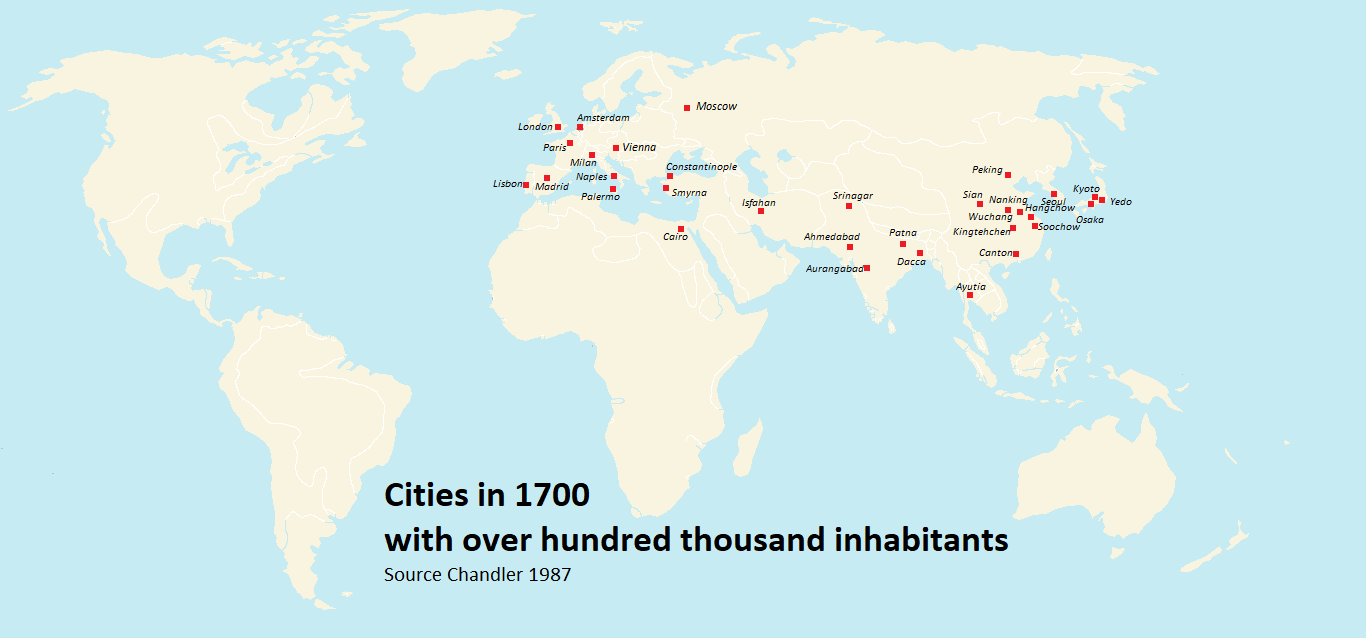
This map shows every city that had more than 100,000 people back in 1700. Most are in Asia. Beijing, Isfahan, Constantinople, Edo (which became Tokyo), Guangzhou. These were already huge urban centers. Europe had about ten cities this big. The Americas? None.
Two hundred years later, the Industrial Revolution had totally flipped this pattern.
Rank
1700 CE
Population
Modern Country
1
Constantinople
684,000
Turkey 🇹🇷
2
Beijing
655,000
China 🇨🇳
3
Isfahan
550,000
Iran 🇮🇷
4
London
553,000
UK 🇬🇧
5
Paris
530,000
France 🇫🇷
By 1700, European cities had made it into the top five. London was fourth.
Rank
1800 CE
Population
Modern Country
1
Beijing
1,100,000
China 🇨🇳
2
London
959,000
UK 🇬🇧
3
Guangzhou
800,000
China 🇨🇳
4
Edo
688,000
Japan 🇯🇵
5
Constantinople
572,000
Turkey 🇹🇷
Beijing was still number one, but London was catching up fast.
Rank
1900 CE
Population
Modern Country
1
London
6,480,000
UK 🇬🇧
2
Paris
3,330,000
France 🇫🇷
3
New York
3,437,000
USA 🇺🇸
4
Berlin
3,764,000
Germany 🇩🇪
5
Vienna
1,700,000
Austria 🇦🇹
2000-2025: Back to Asia
Rank
2000 CE
Population
Modern Country
1
Mumbai
16,367,000
India 🇮🇳
2
Delhi
13,782,000
India 🇮🇳
3
Tokyo
12,100,000
Japan 🇯🇵
4
Shanghai
13,595,000
China 🇨🇳
5
Beijing
10,162,000
China 🇨🇳
By 2000, Asian cities dominated again. India opened up its economy and urbanization went into overdrive.
Rank
2025
Population
Modern Country
1
Jakarta
41,900,000
Indonesia 🇮🇩
2
Dhaka
39,600,000
Bangladesh 🇧🇩
3
Tokyo
33,000,000
Japan 🇯🇵
4
Shanghai
29,600,000
China 🇨🇳
5
Delhi
30,200,000
India 🇮🇳
Jakarta‘s the most populous now. Forty-two million people. Tokyo held first place just five years ago.
These numbers are for whole metropolitan areas, not just the official city limits. Jakarta spreads across Java island and it’s hard to say where the city actually ends anymore.
In 1975, eight cities had over 10 million people. Now there are 33. More than half are in Asia. African cities are growing the fastest. Addis Ababa, Dar es Salaam, Hajipur, Kuala Lumpur will probably all hit 10 million by 2050.
Japan’s going the other direction. Four Japanese cities are shrinking because of low birth rates and an aging population.
Time Period
Largest City
Population (Millions)
Modern Country
3000-2501 BCE
Uruk
0.08
Iraq 🇮🇶
2500-2251 BCE
Lagash
0.06
Iraq 🇮🇶
2250-2001 BCE
Girsu
0.08
Iraq 🇮🇶
2000-1751 BCE
Isin
0.04
Iraq 🇮🇶
1750-1251 BCE
Babylon
0.06
Iraq 🇮🇶
1250-1001 BCE
Pi-Ramesses
0.16
Egypt 🇪🇬
1000-601 BCE
Thebes
0.12
Egypt 🇪🇬
600-301 BCE
Babylon
0.2
Iraq 🇮🇶
300-201 BCE
Carthage
0.4
Tunisia 🇹🇳
200 BCE-270 CE
Alexandria
0.6
Egypt 🇪🇬
271-350 CE
Rome
0.39
Italy 🇮🇹
351-500 CE
Constantinople
0.49
Turkey 🇹🇷
501-640 CE
Ctesiphon
0.5
Iraq 🇮🇶
641-644 CE
Constantinople
0.4
Turkey 🇹🇷
645-795 CE
Chang’an
0.59
China 🇨🇳
796-963 CE
Baghdad
1.1
Iraq 🇮🇶
964-975 CE
Constantinople
0.32
Turkey 🇹🇷
976-984 CE
Córdoba
0.33
Spain 🇪🇸
985-1144 CE
Bian
0.44
China 🇨🇳
1145-1199 CE
Constantinople
0.24
Turkey 🇹🇷
1200-1275 CE
Lin’an
0.36
China 🇨🇳
1276-1278 CE
Cairo
0.37
Egypt 🇪🇬
1279-1315 CE
Hangzhou
0.43
China 🇨🇳
1316-1348 CE
Cairo
0.5
Egypt 🇪🇬
1349-1353 CE
Hangzhou
0.43
China 🇨🇳
1344-1380 CE
Cairo
0.35
Egypt 🇪🇬
1381-1394 CE
Vijayanagara
0.36
India 🇮🇳
1395-1426 CE
Yingtian
0.5
China 🇨🇳
1427-1441 CE
Vijayanagara
0.44
India 🇮🇳
1442-1612 CE
Beijing
0.7
China 🇨🇳
1613-1678 CE
Constatinople
0.74
Turkey 🇹🇷
1679-1720 CE
Dhaka
0.78
Bangladesh 🇧🇩
1721-1826 CE
Beijing
1.3
China 🇨🇳
1827-1918 CE
London
7.4
UK 🇬🇧
1919-1954 CE
New York
13.2
U.S. 🇺🇸
1955-Present
Tokyo
37.3
Japan 🇯🇵
Which Cities Hit One Million First?
Rome got to one million in 133 BCE. Alexandria hit it in 30 BCE. Then almost a thousand years passed before Angkor reached it. Three more centuries until Hangzhou.
But then the 1800s happened and suddenly five cities crossed one million in 24 years.
Order
City
Country
Year Reached
1
Rome
Italy 🇮🇹
133 BCE
2
Alexandria
Egypt 🇪🇬
30 BCE
3
Angkor
Cambodia 🇰🇭
900 CE
4
Hangzhou
China 🇨🇳
1200 CE
5
London
UK 🇬🇧
1810 CE
6
Paris
France 🇫🇷
1850 CE
7
Beijing
China 🇨🇳
1855 CE
8
Guangzhou
China 🇨🇳
1860 CE
9
Berlin
Germany 🇩🇪
1870 CE
10
Manhattan
USA 🇺🇸
1874 CE
Today there are roughly 501 cities all over the world that have more than a million residents. It sounds like quite a few until you think about how that’s only around 4 percent of the more than 12,000 urban areas out there with at least 50,000 people.
Many cities have crossed the million threshold by this point, but those truly huge ones with ten million or more people remain pretty rare. Right now we have just 33 megacities in that group.
Which Cities Hit Ten Million First?
And speaking of ten million, who made it there earliest? New York started it off in 1950, with Tokyo getting there by 1955. Plenty more joined in the following decades as urban areas expanded fast across the globe.
Order
City
Country
Year Reached
1
New York
USA 🇺🇸
1950
2
Tokyo
Japan 🇯🇵
1955
3
Osaka
Japan 🇯🇵
1965
4
Mexico City
Mexico 🇲🇽
1970
5
São Paulo
Brazil 🇧🇷
1970
6
Buenos Aires
Argentina 🇦🇷
1975
7
Los Angeles
USA 🇺🇸
1975
8
Paris
France 🇫🇷
1975
9
Beijing
China 🇨🇳
1980
10
Rio de Janeiro
Brazil 🇧🇷
1980
Lately a few megacities have actually started to lose population, like Mexico City and Chengdu. Others keep expanding at a crazy pace that’s hard to manage, bringing issues such as too few homes, not enough water, and streets clogged with endless traffic. Delhi may end up bigger than Jakarta sometime near 2030, mostly because India’s overall population is still on the rise as Indonesia’s birth rates drop off. Even with that, though, the largest spots aren’t always the smoothest to live in and they often face even tougher challenges ahead.
Over five thousand years since Uruk got the ball rolling on cities, we haven’t quite figured out the best number of people to pack into one place for things to run well. We’ve pushed it to 42 million in some areas, but that doesn’t mean it’s ideal.