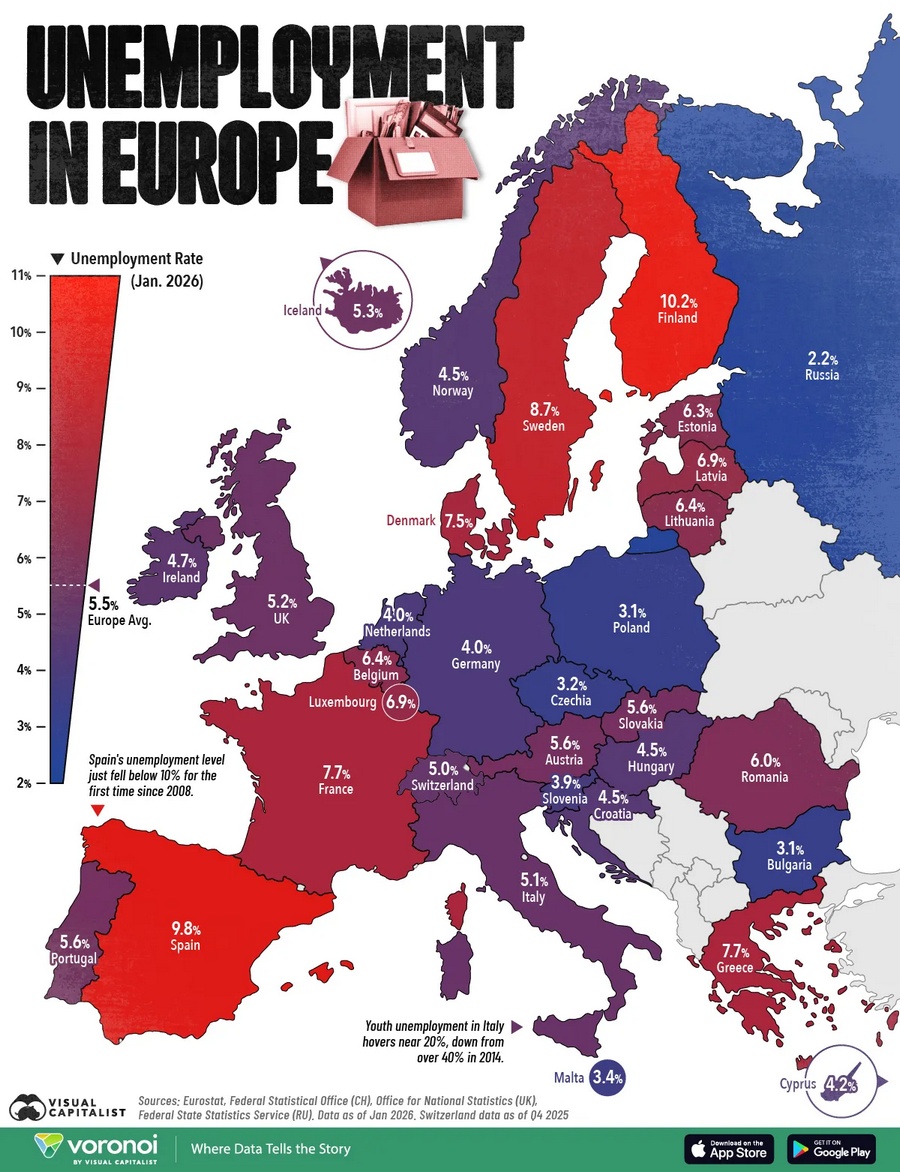
Not long ago, southern Europe was the undisputed center of the continent’s unemployment crisis. Greece had regions where more than a third of the workforce was jobless. Spain was pushing 27% nationally. According to Eurostat’s 2026 data, Finland now has the highest unemployment rate in Europe at 10.2%.
The map below, created by VisualCapitalist, shows unemployment rates across Europe.
Country
Unemployment Rate (Jan 2026)
Finland
10.2%
Spain
9.8%
Sweden
8.7%
France
7.7%
Greece
7.7%
Denmark
7.5%
Latvia
6.9%
Luxembourg
6.9%
Belgium
6.4%
Lithuania
6.4%
Estonia
6.3%
Romania
6.0%
Austria
5.6%
Portugal
5.6%
Slovakia
5.6%
Iceland
5.3%
United Kingdom
5.2%
Italy
5.1%
Ireland
4.7%
Croatia
4.5%
Hungary
4.5%
Norway
4.5%
Cyprus
4.2%
Germany
4.0%
Netherlands
4.0%
Slovenia
3.9%
Malta
3.4%
Czechia
3.2%
Switzerland
3.2%
Bulgaria
3.1%
Poland
3.1%
Russia
2.2%
EU average
5.8%
Three years ago, Finland’s unemployment rate was around 7%. By December 2025, it had climbed to 10.7%, the highest in the entire EU. What pushed it there wasn’t one bad year or a financial shock. The economy had been barely growing, private investment stayed weak, and the number of people entering the labor market kept increasing, partly through immigration, faster than jobs were being created.
Spain’s 9.8% puts it second on the list. However, the country’s jobless rate fell below 10% for the first time since the first quarter of 2008. Total employment reached 22,463,300, a record. A country that spent most of a decade above 20% unemployment is now adding jobs at a pace that is hard to argue with, even if the headline rate still looks high by European standards.
At the other end, Bulgaria and Poland both came in at 3.1%, the lowest in the EU, with Russia at 2.2% outside the bloc. Germany and the Netherlands held at 4.0% each, low for economies of their size.