Key Takeaways (place near the top of the post, right under the title)
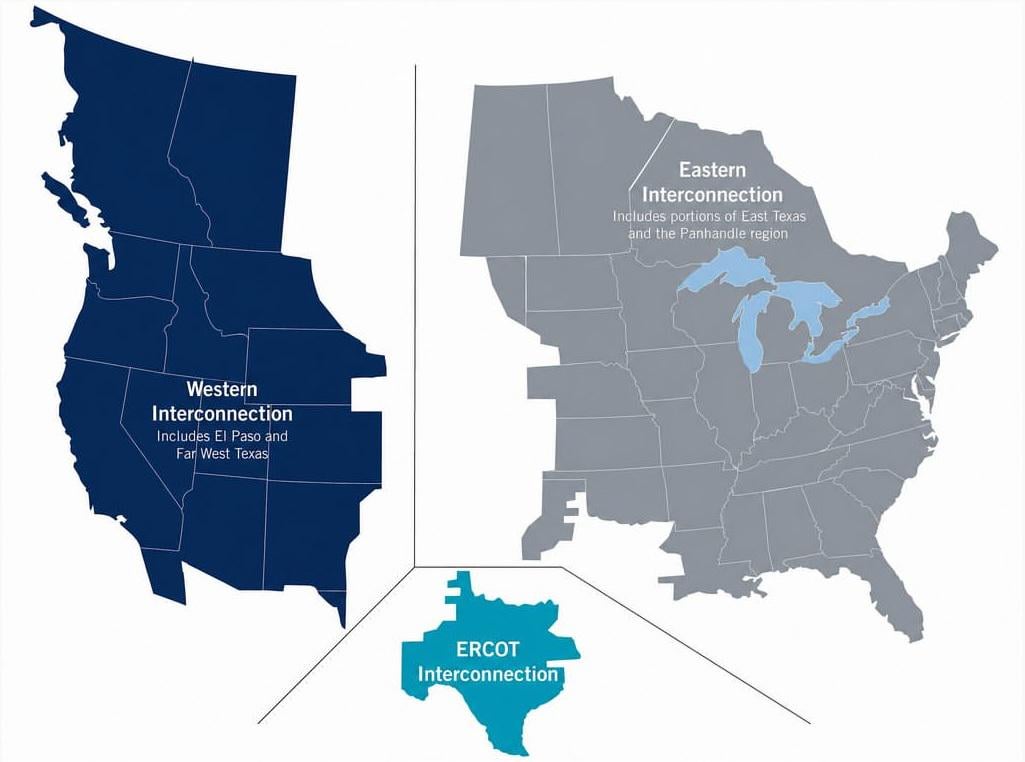
The Lower 48 states operate on three separate power grids, the Western, Eastern, and Texas interconnections, not one connected system.
Texas built its own grid largely to avoid federal oversight under the 1935 Federal Power Act, and has kept it that way since.
The Eastern grid produces roughly seventy percent of the country’s electricity. The Western grid produces about seventeen percent, and Texas about nine percent.
Only a handful of direct current links allow power to cross between the three grids at all.
State lines are a rough guide at best. Parts of Nebraska, Montana, South Dakota, and New Mexico belong to a different grid than the rest of their state does.
Alaska and Hawaii fall outside all three grids entirely, and neither is one connected system on its own either. Alaska has more than 150 separate grids, and Hawaii’s six islands are not tied to each other.
In February 2021, a hard freeze took down power plant after power plant across Texas. The grid came within four minutes and thirty seven seconds of a complete, cascading collapse, one officials said could have left parts of the state dark for weeks. Oklahoma, a few hundred miles north, had power to spare. Almost none of it could reach Texas. That is by design, not by accident. Texas is not plugged into the same electrical system as most of the country. In a stricter sense, the eastern half of the United States is not plugged into the western half either. The Lower 48 states operate on three separate power grids, and the boundaries between them come from history and physics more than from geography.
Where One Grid Ends and Another Begins
Every generator inside one of these systems has to spin in step with every other generator within it, locked to an alternating current frequency of sixty cycles a second. That shared rhythm is what makes an interconnection a single system.
The Western Interconnection covers the Rockies west to the Pacific, all of Arizona, California, Idaho, Nevada, Oregon, Utah, and Washington, plus pieces of several neighboring states.
The Eastern Interconnection covers most of everywhere else, some thirty six states plus Washington, D.C. The two do not share a frequency. Power crossing between them has to pass through back-to-back converter stations that turn alternating current into direct current and back again, and the total capacity across that seam is only about 1,320 megawatts, a narrow doorway between two enormous rooms.
None of it was planned from a single desk. The three way split grew out of decades of individual utilities linking up with their nearest neighbors, mostly between 1960 and 1990, until three distinct systems became visible almost by accident. State lines are a rough guide to the boundary at best. Slivers of Nebraska, Montana, South Dakota, and New Mexico fall on the Eastern side even though most of their state belongs to the West.
Texas Stayed Out on Purpose
Texas is the only one of the three built to stand apart on purpose. The 1935 Federal Power Act gave federal regulators authority over any electricity sold across state lines. Texas utilities kept their wires inside the state and stayed outside that reach. During the Second World War, several of those utilities linked into the Texas Interconnected System to keep war plants running, proving a statewide grid could work without ever leaving Texas. The arrangement held for decades, mostly. In 1976 one Texas utility quietly sent power to an Oklahoma sister company for a few hours, an episode now known as the Midnight Connection. The legal fight that followed nearly pulled Texas into the national system. It ended in the state’s favor instead. A major 1965 blackout pushed the whole industry toward tighter coordination. The Electric Reliability Council of Texas (ERCOT) grew out of that push, created in 1970, and has managed the grid since. ERCOT now covers about 200,000 square miles, or 518,000 square kilometers, close to seventy five percent of Texas by land area, and delivers around ninety percent of the state’s electricity. El Paso, a piece of the Panhandle, and the areas around Beaumont and Texarkana were never folded in. They still draw power from the Western or Eastern grids instead.
The isolation has company outside the Lower 48. Quebec operates its own grid for reasons that echo Texas’s. It was formally recognized by grid regulators as a fourth North American interconnection in 2006, specifically because it operates out of step with its neighbors. Alaska and Hawaii answer to no interconnection at all, and neither is one grid internally either. Alaska operates on more than 150 separate systems. The largest is the Railbelt, linking Fairbanks to Anchorage and the Kenai Peninsula, and even that is held together by just two interties with no backup. Hawaii’s six main islands each keep their own grid. Despite decades of study, no cable has ever linked one island’s power to another’s. Three grids cover the Lower 48. Five, once the rest of the continent joins the count. Neither number includes Alaska’s hundred and fifty separate systems, or Hawaii’s six.