Greenland is 81% glacier. The island itself measures 2,166,086 km² (836,109 sq mi), the world’s largest, and the ice resting on top is heavy enough to push the bedrock below sea level in places (22% of Greenland’s central bedrock below sea level).
The population is around 56,000, mostly strung along the western and southern coasts. Nuuk, the capital, holds roughly 20,000 of them and is somehow the world’s northernmost capital city. Sisimiut is next at around 5,500. You get about 10°C in Nuuk in summer. Go inland and that starts to sound warm.
No roads connect most towns. Total paved road: about 150 km, linking one pair of settlements. Boats in summer, small planes otherwise. About 88% of the population is Inuit. Greenland has handled its own domestic affairs as an autonomous territory within Denmark since 2009. The northeastern section is entirely national park, 972,000 km² of it, bigger than Egypt, no permanent residents.
Until recently, the geology was mostly of interest to geologists. Then 2019 happened.
Reading the Rocks
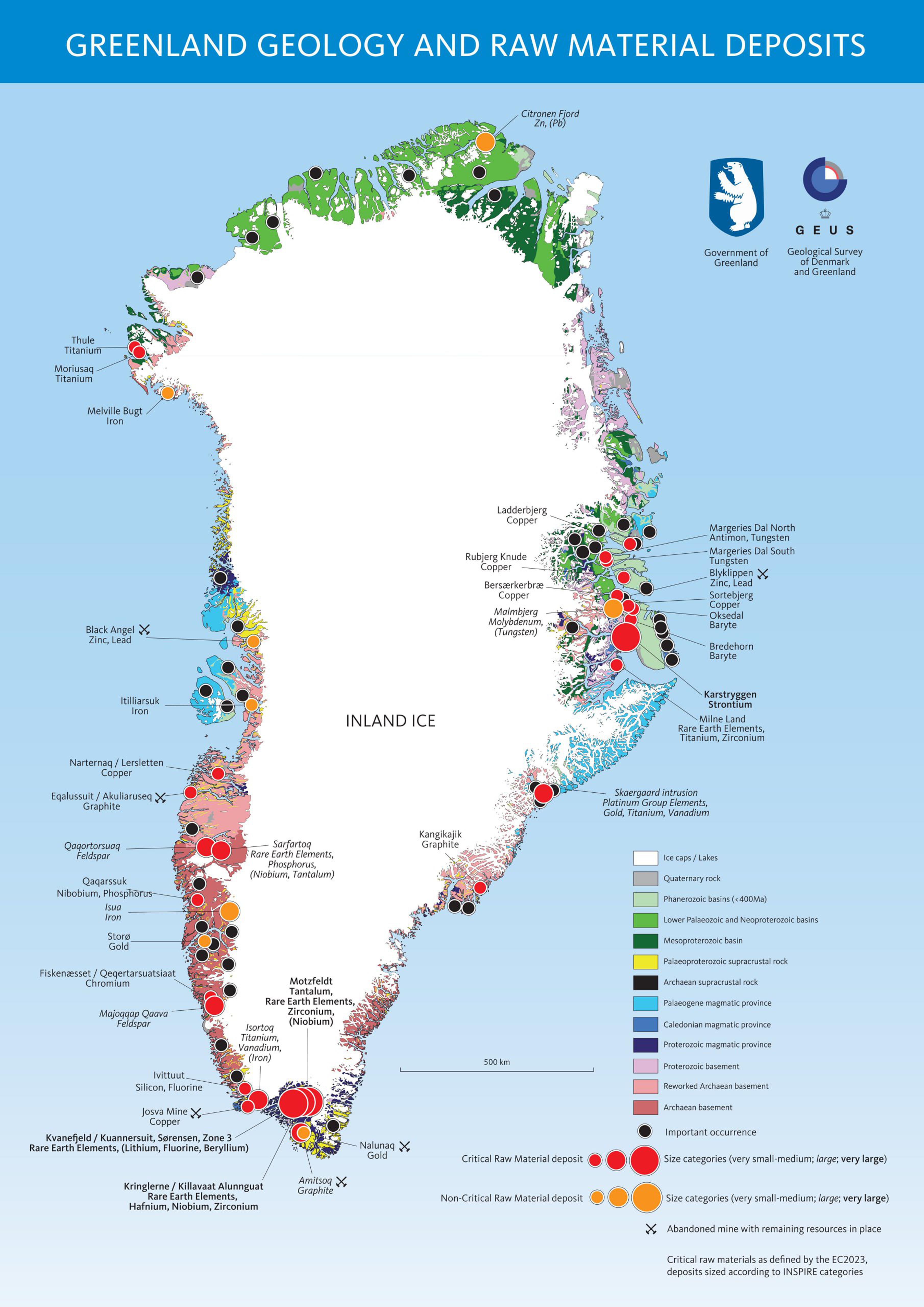
This map covers the whole island and charts mineral deposits against the underlying geology. Basement rocks in the south formed roughly 3.8 billion years ago, before any complex life had appeared on Earth. Younger Proterozoic belts built up around that core over hundreds of millions of years after that. When the North Atlantic started opening around 60 million years ago, the western coast got a wave of magmatic activity that produced the Gardar alkaline province in the south. Alkaline igneous systems have unusual chemistry, and that chemistry generated mineral concentrations you simply don’t find in ordinary rock. On the map, look at the southern tip. The deposit symbols are so densely packed that labels start overlapping.
GEUS published a survey in 2023 putting 25 of the EU’s 34 critical raw materials inside Greenland’s borders. Most attention lands on two deposits near Narsaq, a small town in the south. Kvanefjeld has a verified resource of 1.01 billion tonnes carrying roughly 11 million metric tons of rare earth oxides. It should be one of the most significant mining operations on the planet. Uranium is the issue. The ore runs 250 to 350 ppm, and in 2021 Greenland’s parliament banned uranium mining. Kvanefjeld has been stuck ever since. Everyone references it. Nobody mines it. Nearby Tanbreez is actually moving. It has an exploitation license and is targeting production around 2028. Its 28.2-million-tonne resource contains over 27% heavy rare earth elements. The global average is about 5 to 10%. Those are what go into EV motors and wind turbines.
Citronen Fjord near the northern tip holds 85 million tonnes of zinc-lead ore, one of the largest undeveloped zinc deposits on the planet, which is a lot less useful when ships can only reach it in summer. The Amitsoq graphite deposit in the south got a 30-year exploitation license in December 2025. It hadn’t been worked since 1922. Projected output around 80,000 tonnes of concentrate a year.
Deposit
Primary Minerals
Verified Resource
Kvanefjeld (Kuannersuit)
REE, Uranium, Zinc, Fluorine
1.01 billion tonnes (JORC); approx. 11 million t REE oxides. Blocked by 2021 uranium ban
Tanbreez
REE, Zirconium, Niobium
28.2 million tonnes; over 27% heavy REEs
Citronen Fjord
Zinc, Lead
85 million tonnes (JORC 2021); ore reserve 48.8 million tonnes at 4.7% zinc
Isua
Iron ore
Projected approx. 15 million tonnes per year
Amitsoq
Graphite
Approx. 80,000 t concentrate per year projected; 30-year license granted Dec 2025
Nalunaq
Gold
Active since 2023; full reserve figures not yet published
The politics entered in 2019, when Trump floated buying Greenland. Denmark said the idea was absurd. Greenland said the same. Then Trump won in 2024 and the idea came back. This time it had tariff threats against Denmark attached. Waltz, his national security adviser, spelled out the logic as minerals, Arctic access, and national security. Greenland and Denmark said no. By January 2026 at Davos, Trump had shifted to a “framework of a future deal” with NATO’s Rutte. No details have been shared.
That proposal sounds brillant, but the geology is only part of the reason Trump wants Greenland. It is necessary to acquire Greenland, due to the fact that it lies in a strategic place that would allow the US, and Canada, to intercept potential ICBMs coming from hostile countries. Control of Greenland would be essential, in order to defend North America to the best of our ability.


That proposal sounds brillant, but the geology is only part of the reason Trump wants Greenland. It is necessary to acquire Greenland, due to the fact that it lies in a strategic place that would allow the US, and Canada, to intercept potential ICBMs coming from hostile countries. Control of Greenland would be essential, in order to defend North America to the best of our ability.
Yes, that’s true. It helps provide strategic control of the North Pole region. https://vividmaps.com/who-controls-the-north-pole/