In September 1655 Dutch soldiers sailed up the Delaware River and took New Sweden, a colony that never had more than about 400 people. Nine years later the Dutch lost New Amsterdam to the English.
In 1650 the English colonies held about 50,000 people, while New France counted only 3,215 in 1666 and New Sweden never passed about 400. Spain held the oldest settlements, such as St. Augustine from 1565. The Dutch and Swedish colonies were the shortest lived, lost between 1654 and 1664.
Key Takeaways
The English colonies grew from 350 people in 1610 to 50,368 in 1650 and 151,507 in 1680.
New Sweden peaked at about 400 colonists.
Dutch Brazil surrendered in January 1654, New Sweden fell in September 1655 and New Amsterdam was captured in August 1664.
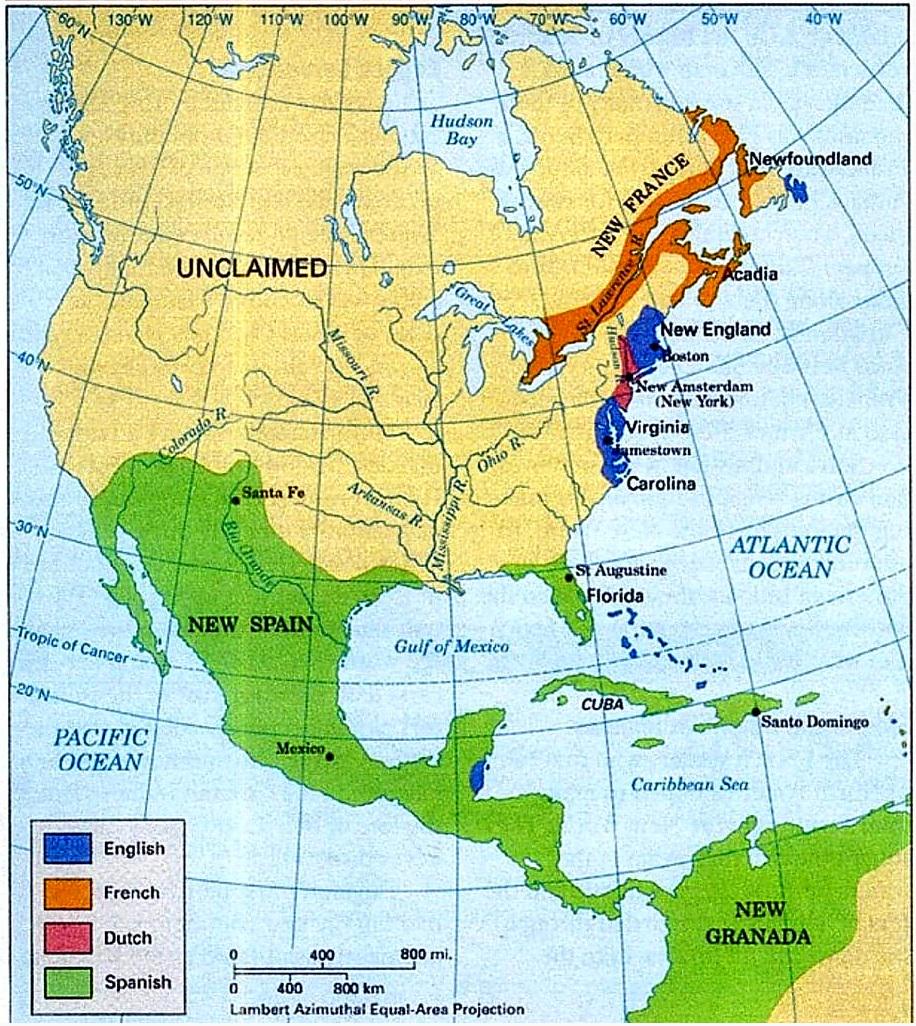
The first map covers the whole New World and sorts it into English, French, Dutch and Spanish holdings, the Spanish ones including New Spain, Florida, Cuba and New Granada.
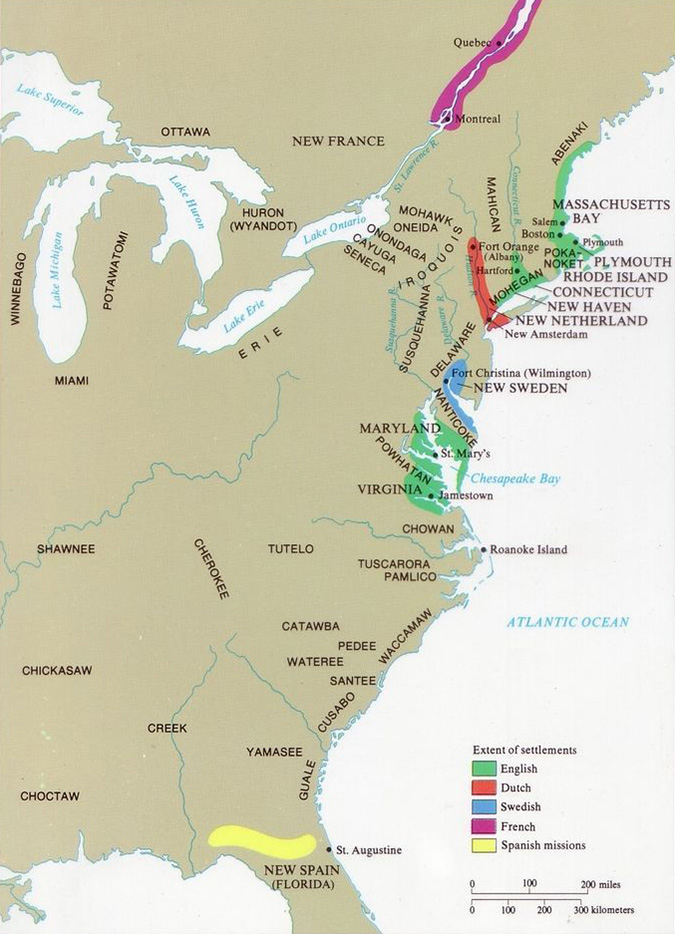
The second zooms in on part of North America, adds Swedish settlements and Spanish missions, and places Native tribes next to the European towns.
Empire
Colonies by 1650
Population
Main Settlements
English
Virginia, Plymouth, Massachusetts Bay, Maryland
50,368 (1650)
Jamestown (1607), Plymouth (1620), Boston (1630), St. Mary’s City (1634)
Fort Orange (1624,) New Amsterdam (1625), Recife (1630)
Swedish
New Sweden
About 400 at its peak
Fort Christina (1638)
Spanish
New Spain, Florida, Cuba, New Granada
N/A
Mexico City (1521), Havana (1519), Cartagena (1533), Bogotá (1538), St. Augustine (1565), Santa Fe (1610)
Spain had been there the longest. St. Augustine is the first permanent European settlement in what became the United States. English growth was uneven, though. About 15,000 settlers reached Virginia between 1622 and 1640, yet its population rose only from 2,000 to 8,000.
New France was thinner. Jean Talon’s census found 3,215 people, with 547 in Quebec and 455 in Trois-Rivières. New Sweden grew to about 200 people during the 1640s and had dwindled to about 130 by 1654.
The Dutch lost ground fastest
The Dutch surrendered Recife on January 26, 1654, ending Dutch Brazil. Some of its Dutch settlers had already left for Suriname, Curaçao and New Amsterdam.
A year later the Dutch took New Sweden. In August 1664 the English captured New Amsterdam, and a brief Dutch reconquest in 1673 did not change the outcome. The post on New Netherland and New Sweden covers both colonies in more detail.