Right now, the oceans are creeping higher – about 5.9 millimetres (0.23 inches) in 2024, according to NASA. It’s a small change you wouldn’t notice day to day, but over the span of decades it reshapes coastlines and leaves coastal towns and cities more exposed to flooding.
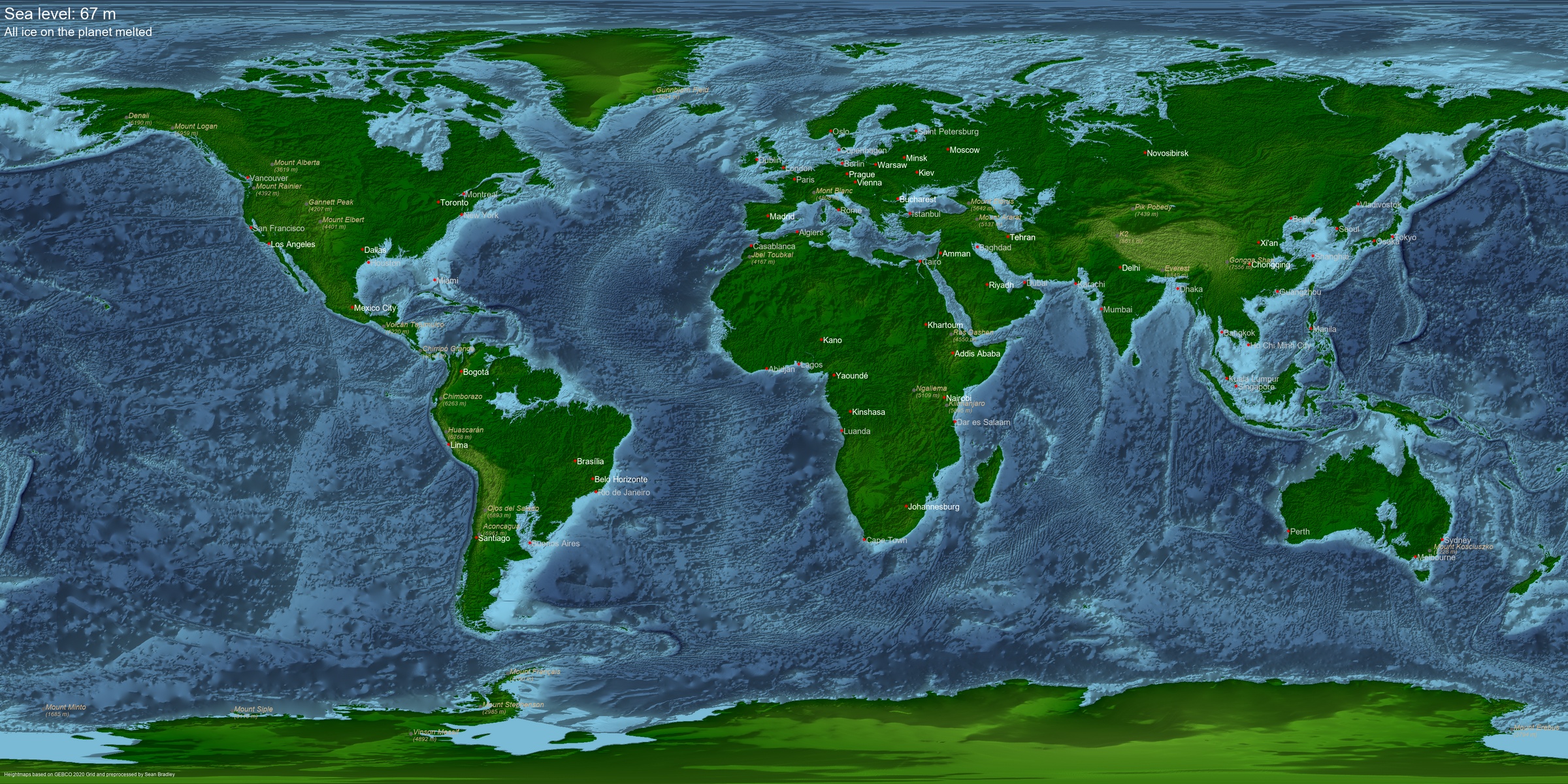
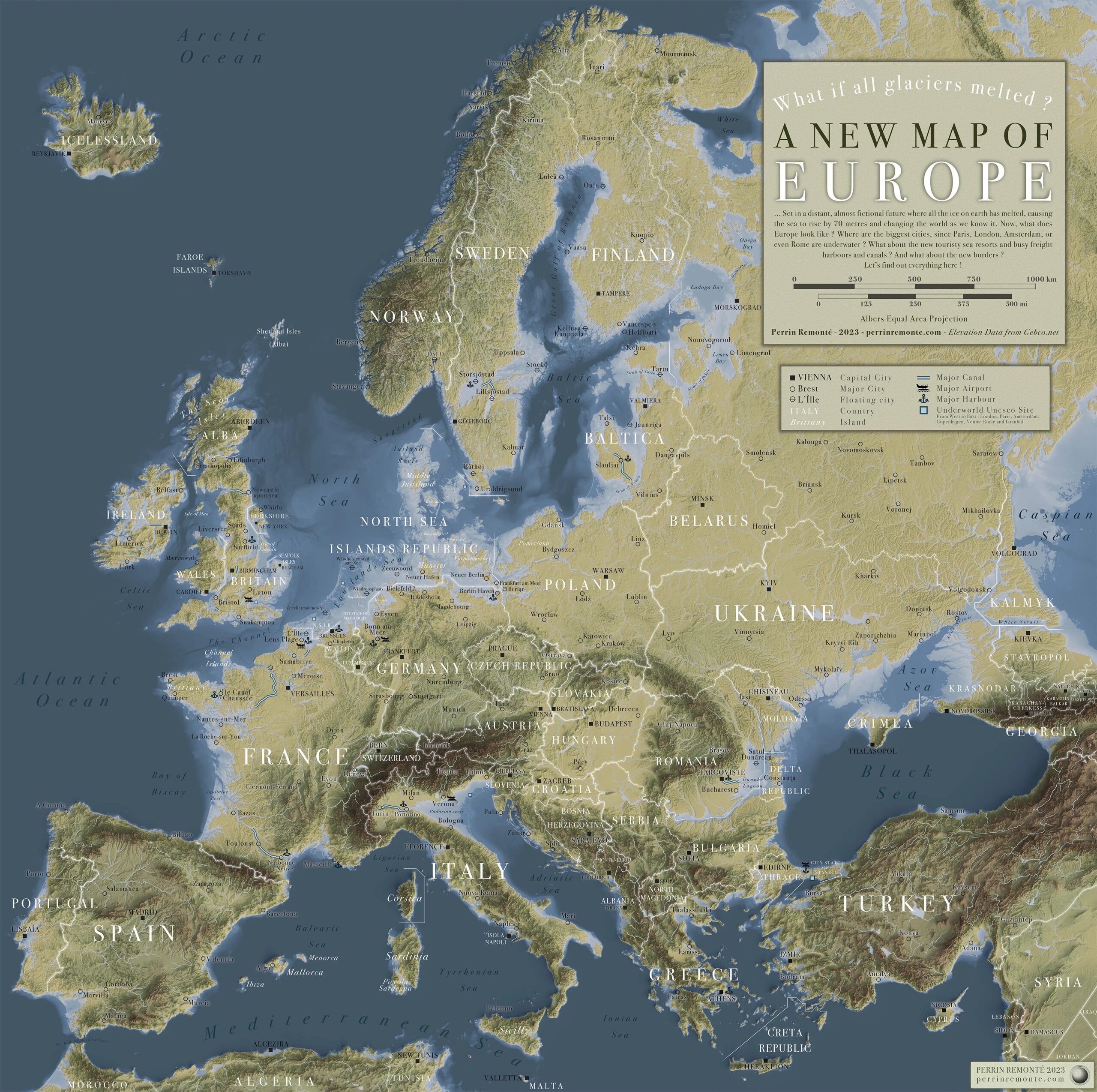
Looking farther ahead – not just a century but thousands to millions of years – the numbers become much larger. If every glacier and ice sheet on our planet melted, global sea level would rise by roughly:
Ice source
Water volume (million km³)
Sea-level rise
Greenland
2.9
~7 m
Antarctica
27
~58 m
All ice
30.1
~66 m
I built maps to show these changes, using height data from the GEBCO 2020 Grid, preprocessed by Sean Bradley.
But I didn’t stop there. I decided to “flood” the planet even further – at least hypothetically. What if Earth received the hidden oceans of other worlds in our Solar System?
Earth’s oceans today contain about 1,335 million km³ of liquid water. But in the Solar System, you can find worlds that can boast of a huge amount of water. Even Pluto likely hides beneath its crust a little less water than our planet.
Here’s how much water a few other ocean worlds might add to our seas:
Celestial body
Liquid water volume (million km³)
Sea-level rise on Earth
Enceladus
10
~27.7 m
Triton
30
~83.1 m
Dione
140
~388 m
Pluto
1,000
~2.8 km
Europa
2,600
~7.2 km
Callisto
5,300
~14.7 km
Titan
18,600
~51.5 km
Ganymede
35,400
~98 km
At that point, our planet would turn into a water world, covered with a multi-kilometer layer of water. For the purposes of visualization, I stopped at Europa – because even Callisto’s water is nearly four times greater than Earth’s.
Below is the animated map I created. It shows major cities fading as they go underwater, while the highest peaks slowly vanish from view as they are submerged.
But while pouring alien oceans onto Earth is just a thought experiment, the opposite direction—our oceans shrinking away—is not. That is the real fate of this planet.
As the Sun slowly brightens, Earth will eventually cross a threshold called the moist greenhouse effect. Once that happens, water vapor will rise high into the atmosphere, break apart under solar radiation, and escape into space.
Models suggest this will begin in about 2.1 billion years. After that tipping point, the oceans could be lost in less than 200 million years—a blink in geologic time.
We are used to considering our planet as something permanent. But the time will come when even the planet will be unsuitable for life, at least in the form that exists now. Therefore, let us take care of our planet and not shorten the time of our possible stay on it.