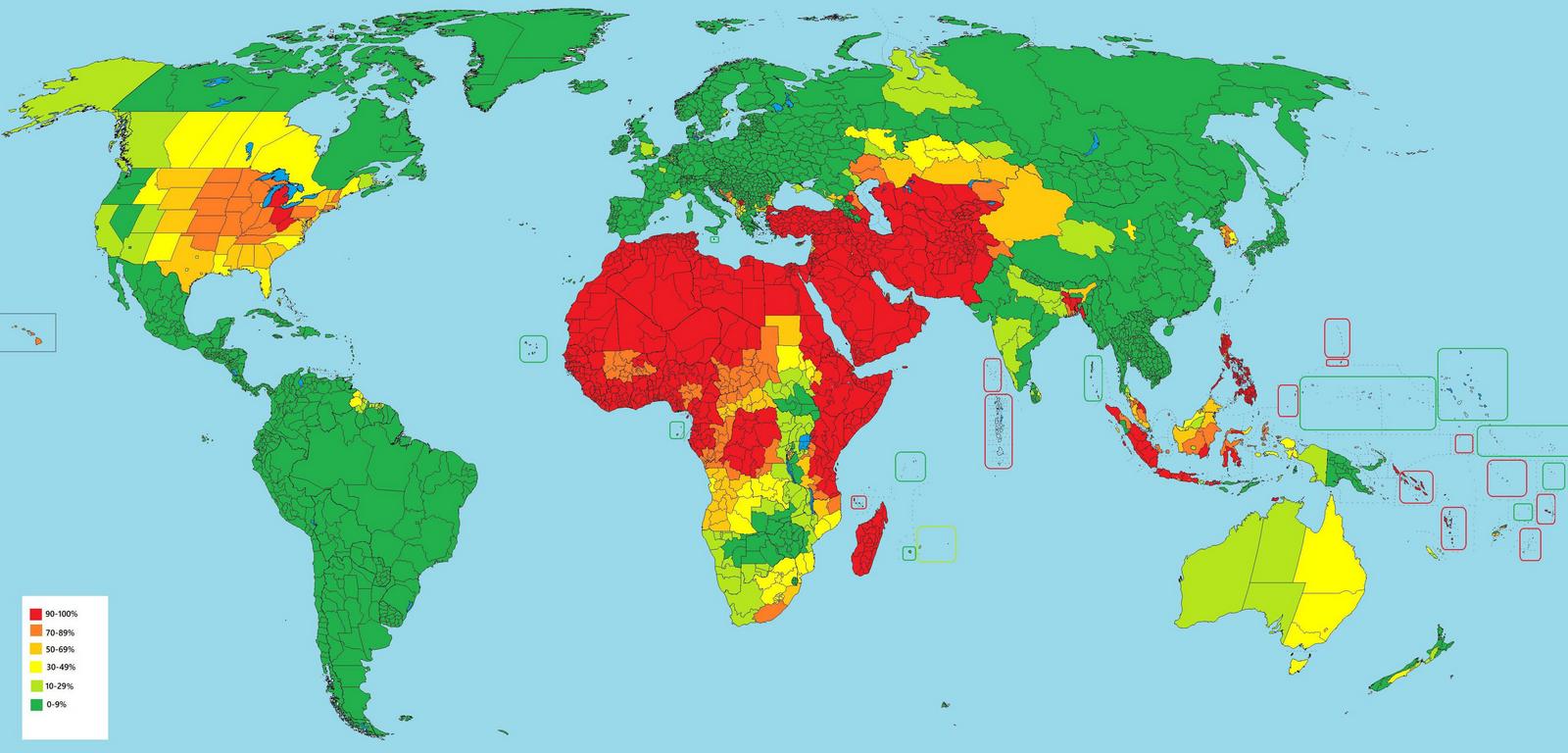
Morocco is at 99.9%. Poland is at 0.11%. Few customs split a world map as sharply as male circumcision, and the dividing lines follow religion, history and in some places an insurance policy more than geography. The maps below show where the practice is nearly universal, where it is rare, and how the United States became a Western outlier.
Between 30% and 39% of men worldwide are circumcised, depending on the estimate. Rates top 90% across most Muslim-majority countries and much of Africa, and fall below 1% in countries such as Poland, Vietnam and Honduras. The United States is estimated at 71.2%, far above Canada, Australia and the United Kingdom, although newborn rates there have been falling.
Key Takeaways
The WHO and UNAIDS estimated about 30% of males were circumcised in 2007. A 2016 peer-reviewed estimate put it at 38.7%.
Adult prevalence exceeds 90% in 63 countries.
The US estimate is 71.2%. Canada is 31.9%, Australia 26.6% and the UK 20.7%.
US newborn hospital circumcision fell from 54.1% in 2012 to 49.3% in 2022.
In 2010, newborn rates were 40.2% in the US West and 71.0% in the Midwest.
How many men are circumcised worldwide?
A 2007 report from UNAIDS put the global figure at about 30% of males and estimated that roughly two thirds of them are Muslim. A 2016 peer-reviewed estimate came in higher, at 38.7% of all males and 36.7% for men aged 15 to 64. The authors credit newer survey data, the growing Muslim share of the world population and HIV prevention programs in Africa.
Method matters here. For 136 countries the 2016 study had no survey and estimated prevalence from religion, assuming 99.9% of Muslim and Jewish males are circumcised and almost no one else. Those values are modeled, not measured.
The HIV programs have a clear origin. In 2007 the WHO and UNAIDS recommended circumcision in high-HIV regions after trials in Kenya, South Africa and Uganda found about a 60% lower risk of heterosexual infection in men.
Which countries have the highest and lowest circumcision rates?
Muslim-majority countries fill the top of the ranking, along with Israel and large parts of West and East Africa. Poland, Czechia, Hungary and Slovakia all fall below 1%, as do most of Central America’s countries.
Albania is the exception. Surveys found 47.7% of men circumcised, yet 77.9% of its population is Muslim.
Country
Share of males circumcised (%)
Morocco
99.9
Afghanistan
99.8
Iran
99.7
Nigeria
98.9
Turkey
98.6
Egypt
94.7
Indonesia
92.5
Philippines
91.7
Israel
91.7
Kenya
91.2
South Korea
77.0
United States
71.2
South Africa
44.7
New Zealand
33.0
Canada
31.9
Australia
26.6
United Kingdom
20.7
India
13.5
Germany
10.9
Japan
9.0
Brazil
1.3
Poland
0.11
Why is the United States an outlier among Western countries?
Canada, Australia and the UK all sit between roughly 20% and 33%, while the US estimate is 71.2%. Hospital routine and insurance coverage explain part of the gap. A CDC analysis found that hospitals in states where Medicaid paid for routine newborn circumcision had rates 24 percentage points higher than hospitals in states without coverage. In 2009, 33 states covered it and 15 did not.
How do circumcision rates differ across the United States?
The CDC’s hospital discharge data split the country into four regions. The West fell from 63.9% of newborns in 1979 to 40.2% in 2010, with a low of 31.4% in 2003. The Midwest peaked at 82.9% in 1998 and stood at 71.0% in 2010. These figures count only circumcisions done during the birth stay, so ritual procedures and later ones are excluded. The series reports regions, not states.
Region
1979
2010
Midwest
74.3
71.0
Northeast
66.2
66.3
South
55.8
58.4
West
63.9
40.2
United States
64.5
58.3
Are US circumcision rates rising or falling?
Falling. In 2012 the American Academy of Pediatrics concluded that the health benefits outweigh the risks but stopped short of recommending the procedure for every newborn, leaving the decision to parents. A later JAMA Pediatrics analysis of more than 1.5 million hospital births found newborn circumcision dropped from 54.1% in 2012 to 49.3% in 2022.
The drop was uneven. Black and Hispanic newborns stayed close to their 2012 levels, while White newborns fell by about five points. The researchers pointed to distrust of medical advice, the growth of the Hispanic population and 17 states that had ended Medicaid coverage by 2011.
US newborn circumcision by group, hospital births (%)




Recommended book: “Dear Editor & Beyond” from Amazon
Several interesting chapters against circumcision, – the cruelest cut!