Over 8 billion people now live on this planet, and certain ethnic groups have been remarkably effective at growing their share of that number over centuries.
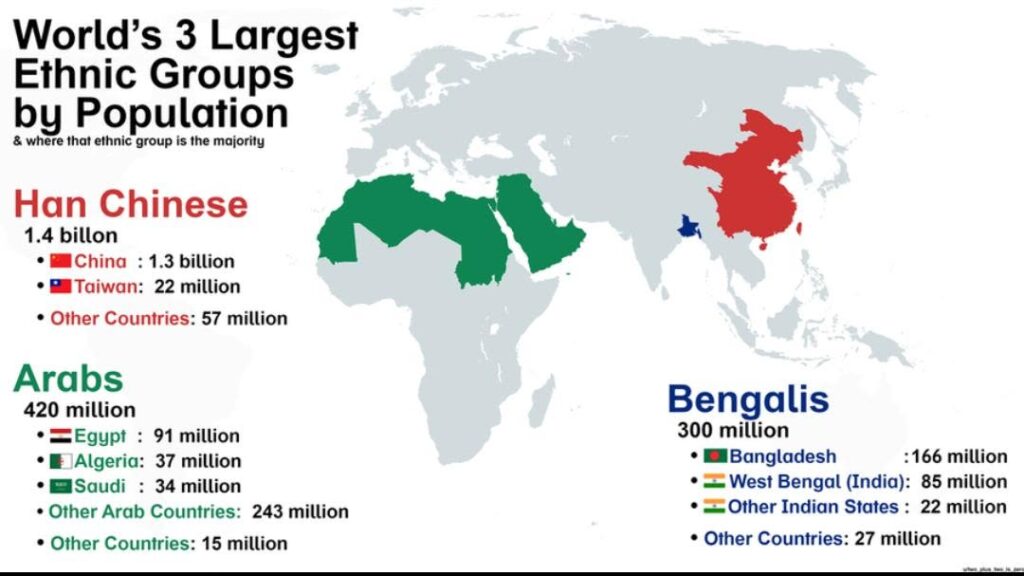
Han Chinese: 1.4 billion people
More than 1.4 billion Han Chinese live on Earth, making up roughly 91% of China’s population and about 17% of the entire world. The group traces its roots to the Yellow River basin in northern China, spreading gradually across what became inner China over centuries of agricultural expansion. Their name comes from the Han Dynasty (202 BCE to 220 CE), remembered as one of Chinese civilization’s high points.
Outside China, the largest communities are in Southeast Asia, where Han Chinese make up about 75% of Singapore’s population and are a significant presence in Thailand, Malaysia, and Indonesia.
Arabs: approximately 420 million people
Egypt, Algeria, Saudi Arabia, Sudan, Iraq — these countries alone account for a large portion of the roughly 540 to 560 million Arabs living worldwide, of whom around 490 to 500 million are in Arab League states and about 50 million are scattered across diaspora communities. The spread happened differently than with the Han. Arabic-speaking populations did not stay concentrated in one region. After the 7th century, Islam carried the Arabic language and culture across enormous distances in a historically short period, from the Atlantic coast of Africa east through the Levant and Mesopotamia and into Central Asia. Egypt alone has over 116 million people today. The broader Arab region reached 480 million in 2024 and is on track to exceed 540 million by 2030, growing at close to twice the global average.
Bengalis: approximately 300 million people
Around 310 million Bengalis live across the world, most of them split between Bangladesh at roughly 175 million and India’s West Bengal state at around 90 million. The delta formed by the Ganges, Brahmaputra, and Meghna rivers is some of the most productive agricultural land anywhere, which is a large part of why this corner of South Asia ended up so densely populated in the first place. That population got divided in 1947 when Britain partitioned India along religious lines, separating Bengalis between a Muslim-majority east and a Hindu-majority west. The east became East Pakistan, then Bangladesh after the 1971 war of independence. Today close to 8.7 million Bangladeshis live abroad according to the UN’s International Organization for Migration, concentrated mainly in Saudi Arabia, Malaysia, the UK, and the Gulf states.