According to the Nature Conservancy research, just 5% of the global landmass, excluding Antarctica, is untouched by human activity. Where are these last wild places? And what about areas where humans simply don’t live, even if our influence reaches them?
The maps below answer these questions, showing the distribution of uninhabited lands across our planet.
World areas where nobody lives
This map created by Helen McKenzie, shows areas with less than one person per square kilometer.
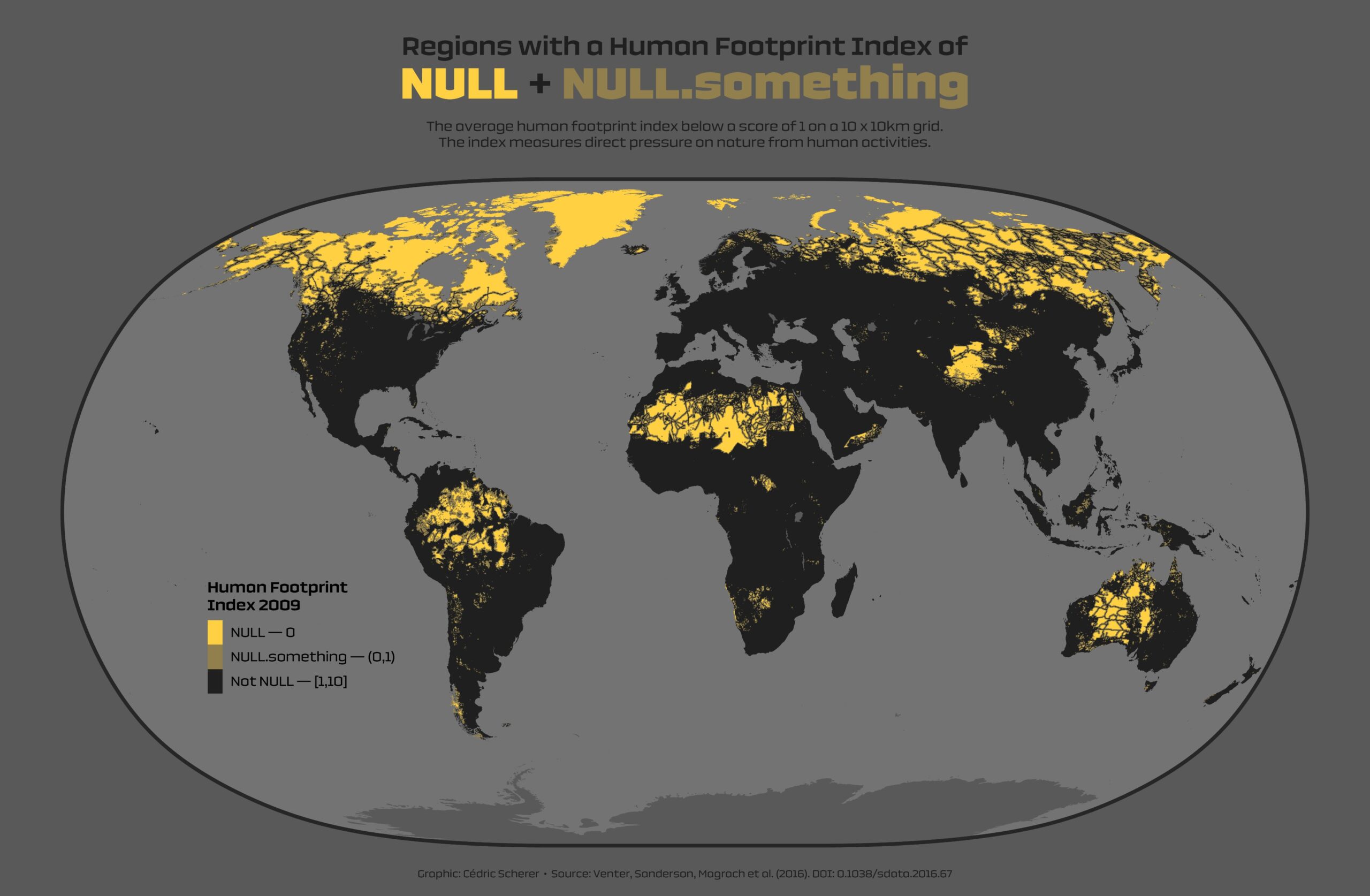
But here’s something worth considering: uninhabited doesn’t always mean wild. Human influence extends far beyond where we build our homes. We can now measure this reach using satellite data. Cédric Scherer mapped regions with no direct human pressures or a very low human footprint index (below 1 on a 10×10km grid, based on NASA’s human footprint data).
What’s the difference between these two maps? The first shows where people don’t live. The second shows where human activity barely registers at all—our true wilderness areas.
Let’s zoom in to see how this plays out across different countries.
Americas
Canada
Canada‘s vast northern territories remain largely uninhabited, creating massive green zones on this population map. The boreal forests, tundra, and Arctic archipelago stretch across millions of square kilometers with virtually no permanent residents.
United States
Did you know approximately 40% of the U.S. population lives in counties along the coast? This concentration leaves substantial interior regions sparsely populated or completely uninhabited.
The Great Basin, large portions of Alaska, and parts of the Mountain West show up as uninhabited census blocks—though many see seasonal use by ranchers, recreationists, and resource extraction operations.
Brasil
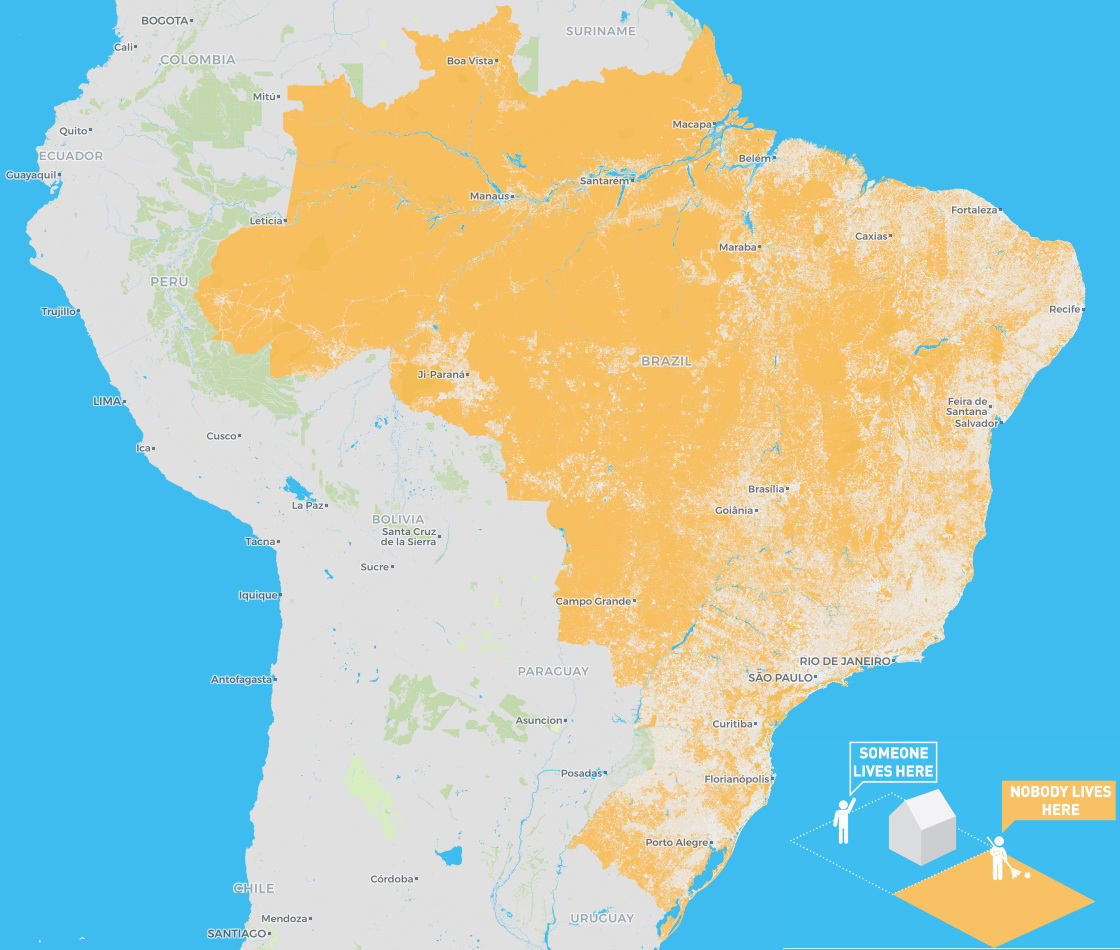
The orange areas on this map represent 1km² tiles where the resident population is null, based on the 2010 Demographic Census Statistical Grid from IBGE (Brazilian Institute for Geography and Statistics).
In 2010, 13.566.488 tiles were surveyed. The reported population in 10.902.382 of them was … zero. This corresponds to 6,8 million km², (2,6 million mi²), roughly 80% of the whole national territory. So, despite its enormous population of 207.7million, most of Brazil’s territory remains uninhabited.
Does that mean that Brazil’s territory is wilderness for the most part?
Definitely no. Yes, many of those tiles cover natural areas, in the Amazon forest, the Pantanal, the pampa, some in protected areas. Nonetheless, uninhabited is not the same as undeveloped nor unexplored.
Much of these uninhabited areas are made up of farmland, commercial and industrial estates, military installations, traffic infrastructure, and other areas where plenty of people pass through – but where nobody actually lives…
Euroasia
United Kingdom
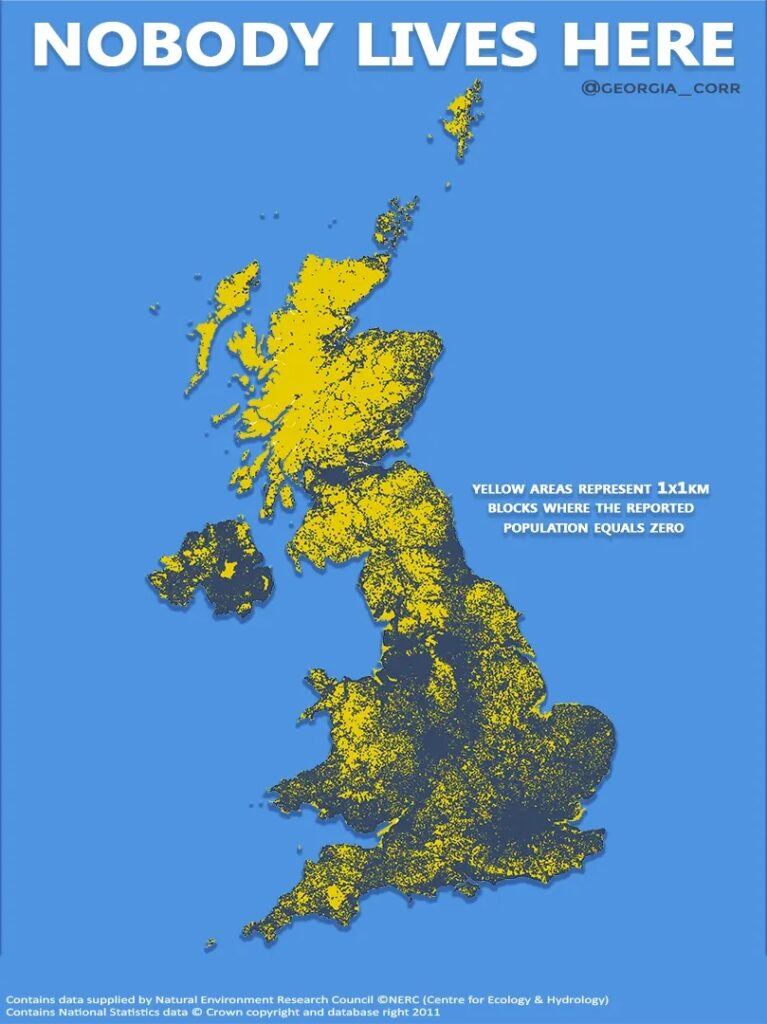
Even in the densely populated UK, pockets of uninhabited land persist—mostly in the Scottish Highlands, Welsh mountains, and moorlands of northern England.
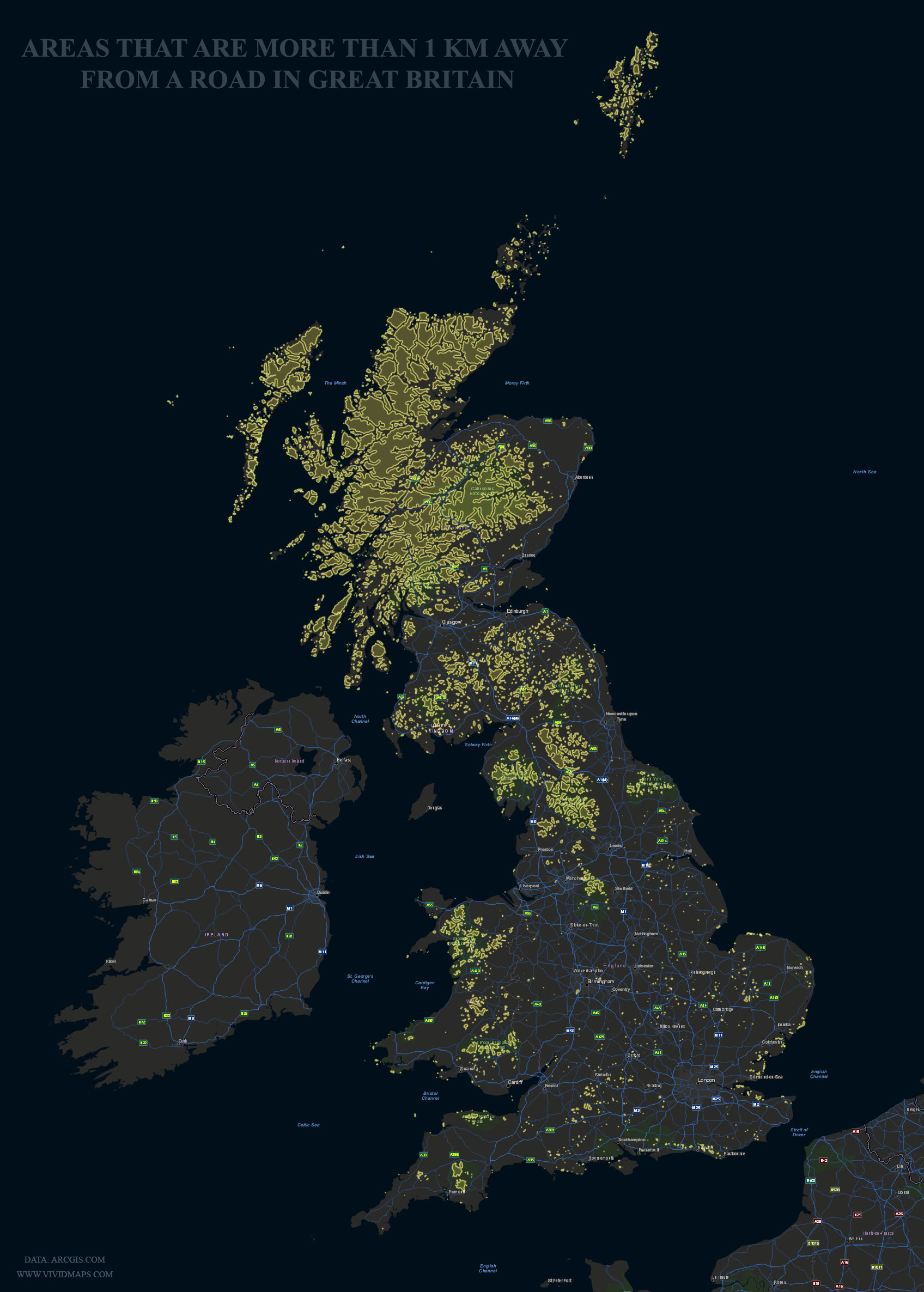
I also created this map showing areas more than 1 km away from any road in Great Britain. It offers another perspective on remoteness:
Areas that are more than 1 km away from a road in Great Britain
The road-distance metric adds another layer to understanding wilderness. You can be in an uninhabited area yet still within walking distance of a motorway.
France
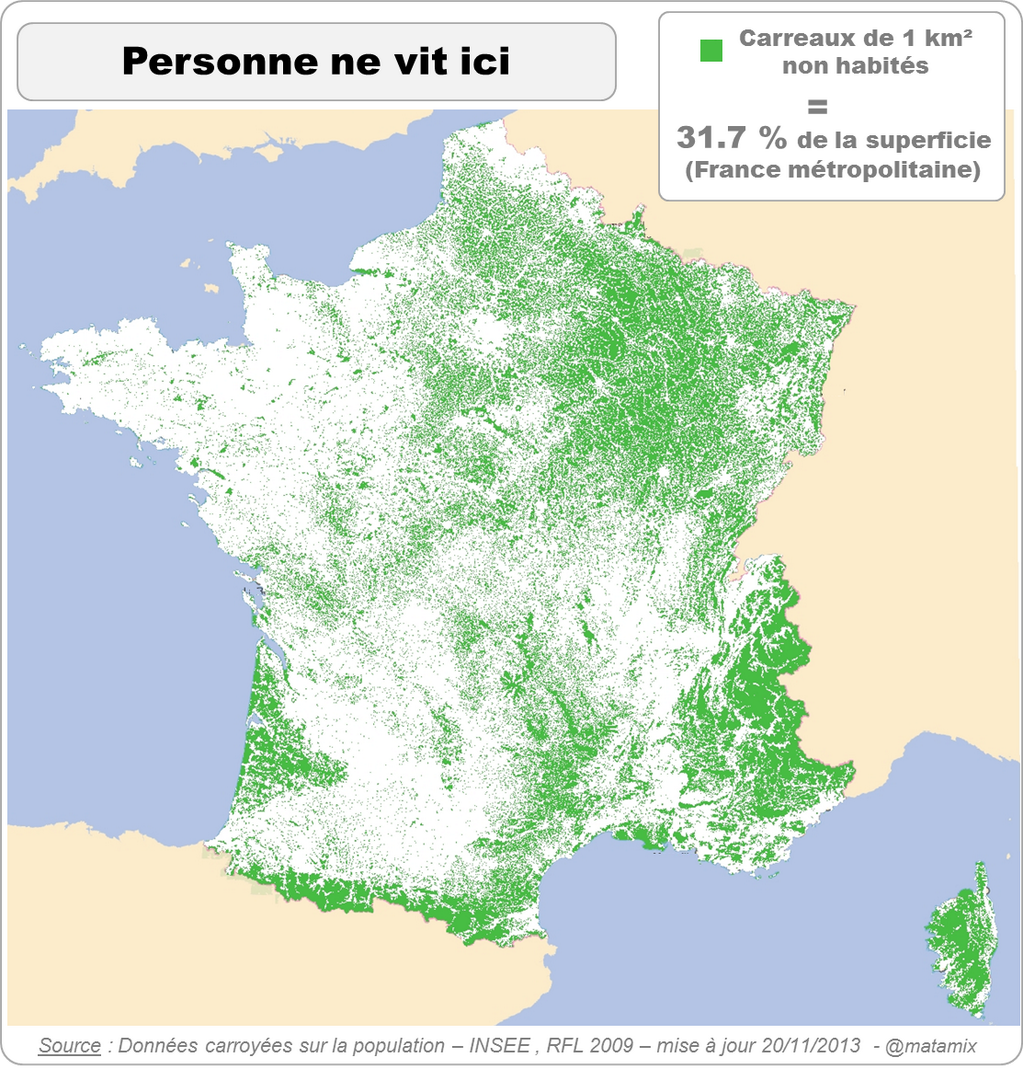
France has substantial uninhabited territory—31.7% of its mainland area. The Massif Central, parts of the Alps, the Pyrenees, and forested regions of central France account for most of these empty spaces.
Netherlands
The Netherlands ranks among the world’s most densely populated countries, with 488 people per square kilometer (1,080 people per square mile). Yet even here, empty spaces exist.
rug.nl/geo
This map displays all 500×500m squares with fewer than 5 inhabitants in green, with populated squares in white. Many green areas are nature reserves, polders, coastal dunes, or agricultural zones where people work but don’t reside.
Norway
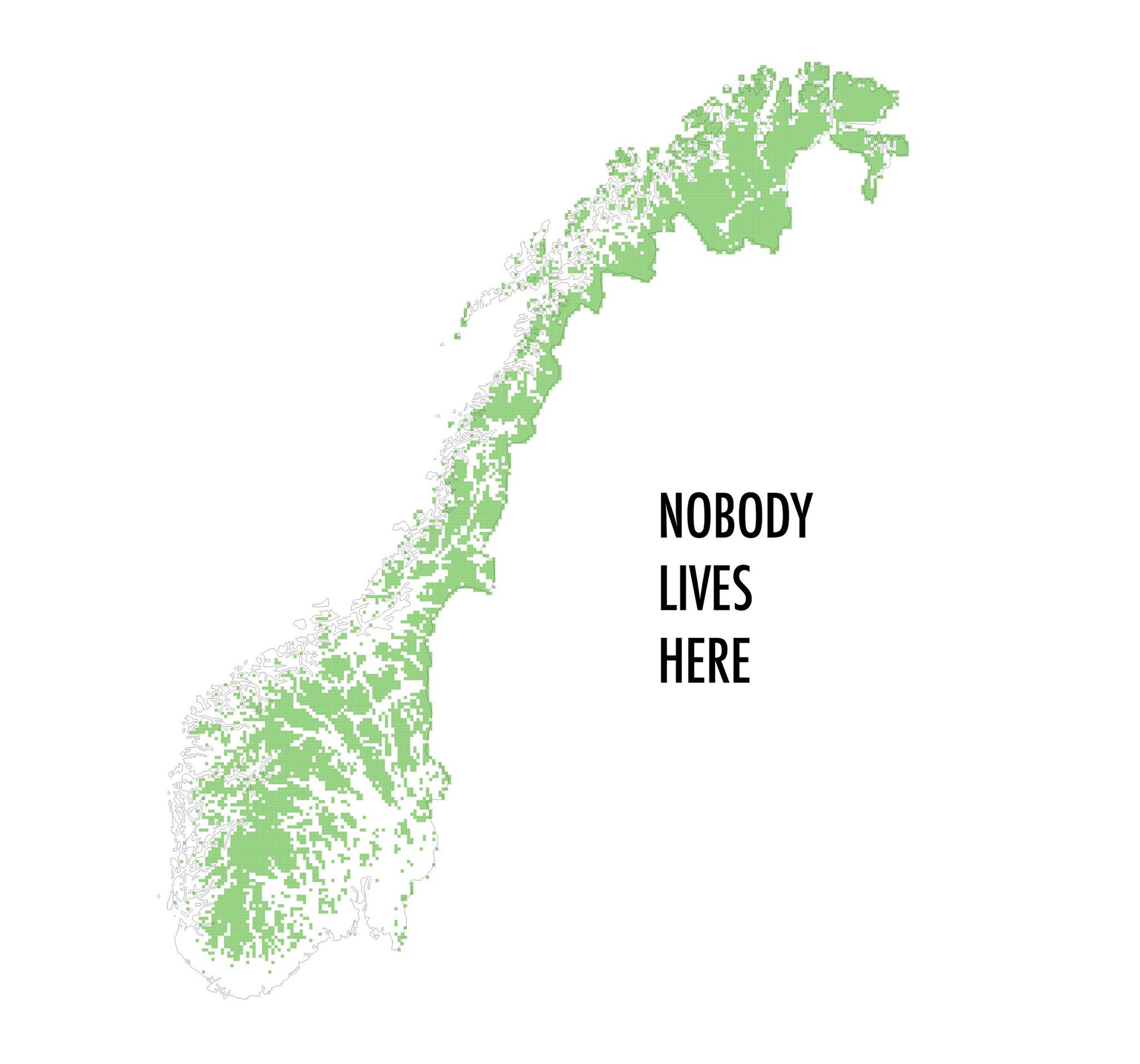
Green blocks of 25 km² (9.7 mi²) on this map show Norwegian areas where nobody lives.
Norway’s mountainous spine and Arctic territories remain largely uninhabited, though not necessarily untouched. Hydroelectric installations, ski resorts, and hiking trails bring human influence into these empty regions.
Finland
Redit user: hezec
Finland presents an extreme case: 60.3% of the country is literally uninhabited, with another 18.8% classified as “almost nobody lives here.” The northern reaches of Lapland account for most of this emptiness.
Oceania
New Zealand
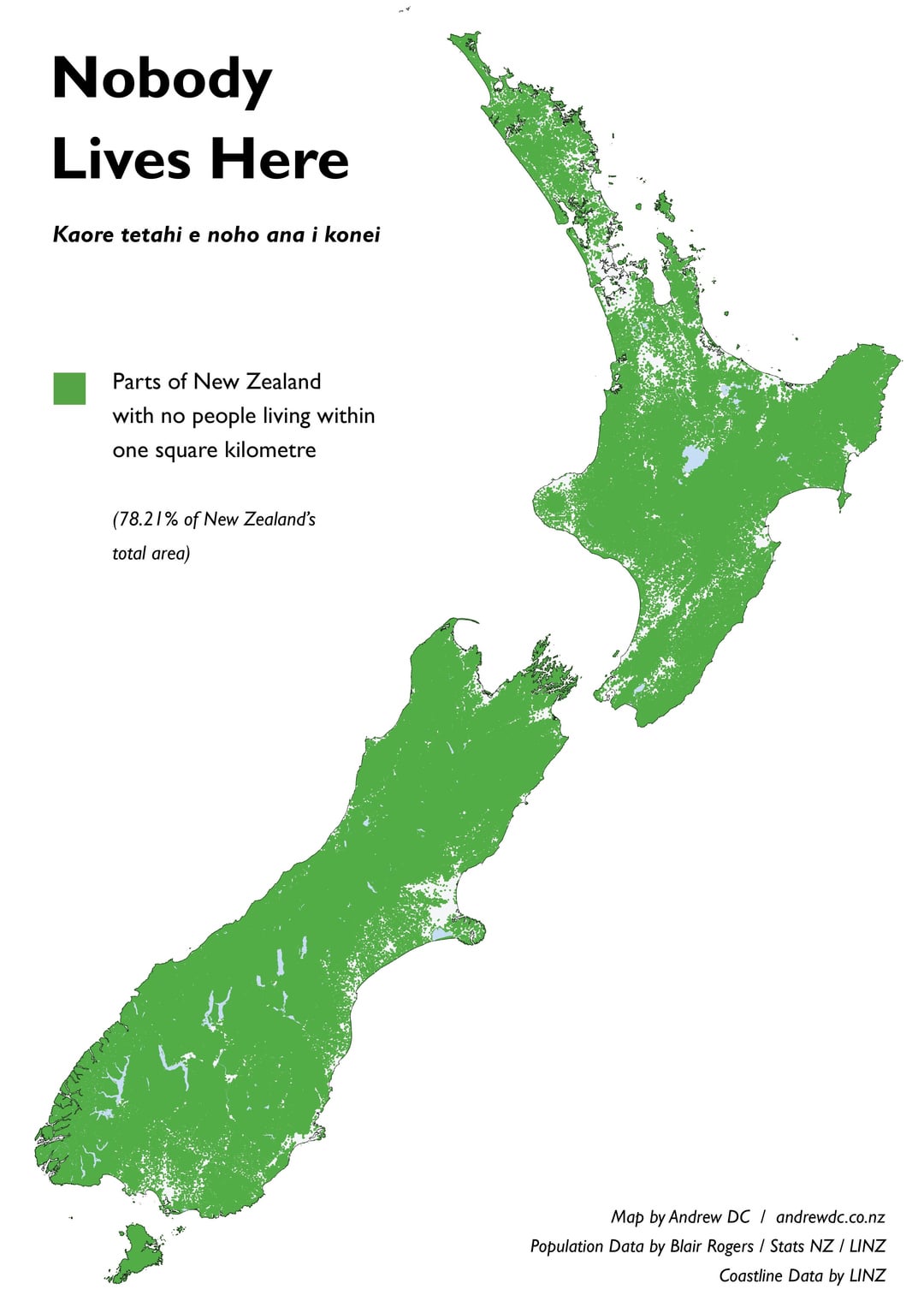
More than three-quarters of New Zealand (78.21%) has no permanent residents. The Southern Alps, Fiordland, and much of the South Island’s interior remain empty of human habitation, though tramping tracks, conservation work, and tourism bring people through regularly.
The Geography of Human Settlement
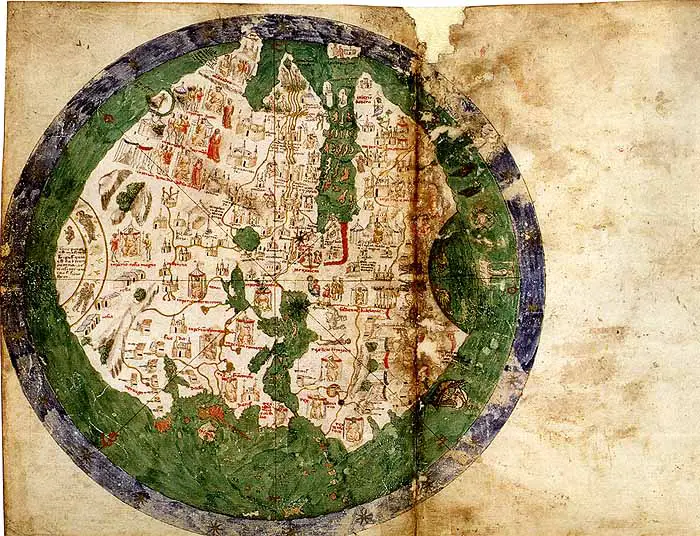
We’ve always chosen to live in places with a comfortable climate and easy access. Naturally, early settlements sprang up along coastlines and river valleys, because water made it easier to travel, find (grow) food, and trade. Later, as civilizations grew, road networks made remote territories more accessible. But the basic preference hasn’t changed.
Empty of people doesn’t mean free from human influence. Unpaved roads cross uninhabited regions. Agricultural operations dominate landscapes with zero residential population. Military bases, mines, logging operations, and infrastructure projects extend our reach far beyond our homes.
That Nature Conservancy figure of just 5% of land truly untouched reminds us that wilderness in the pure sense has become rare. Most “empty” places on these maps bear our fingerprints, even when they lack our footprints.











Urbanization is definitely happening. This just shows how extreme it is.
very cool