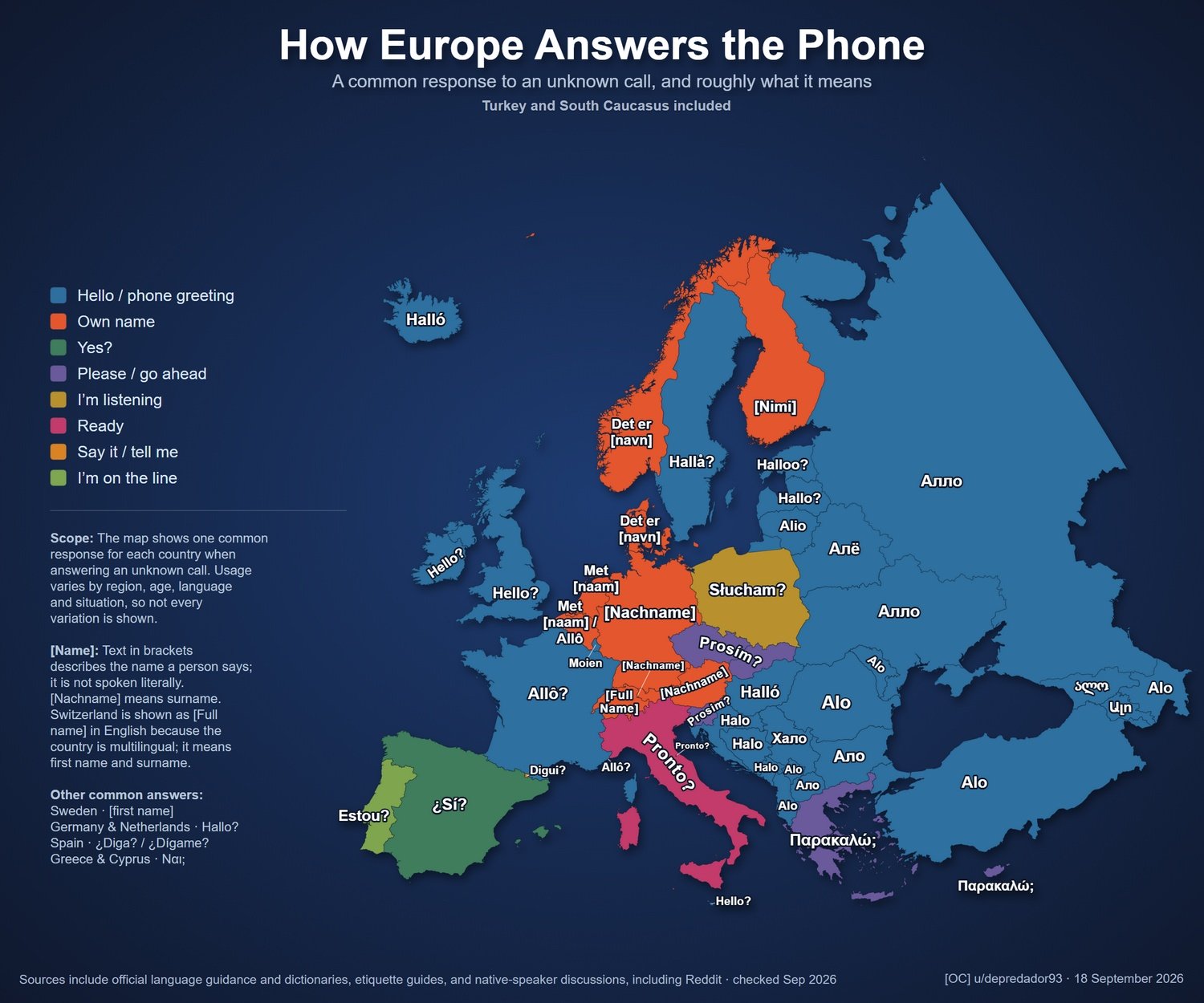
Pick up an unknown call in London and you get a flat “Hello?” Pick up the same call in Rome and the answer is “Pronto,” Italian for ready. In Warsaw it’s “Słucham,” I’m listening. A map below, created by Reddit user depredador93, sorts the entire continent by this habit.
Most of Europe answers an unknown call with some version of hello, from the British “Hello?” to the Russian “Алло” and the Turkish “Alo.” A handful of countries skip that word entirely. Italians say pronto (ready), Germans and Dutch speakers give a name instead of a greeting, Poles say słucham (I’m listening), and Spaniards typically ask ¿Sí? (yes). The word hello itself only became the standard English telephone greeting after a disagreement between Thomas Edison and Alexander Graham Bell in 1877.
Key takeaways
Most of Europe answers an unknown call with a version of hello, including allô, alô, alo, halló and алло.
Italy answers with pronto (ready), Poland with słucham (I’m listening), and Spain’s main answer on the map is ¿Sí? (yes).
Germany, the Netherlands, Denmark and Norway skip a greeting word and answer with a name instead.
Czechs, Slovaks, Greeks and Cypriots all reach for a version of please, handing the floor to the caller.
Hello became the standard telephone greeting after Thomas Edison’s 1877 letter won out over Alexander Graham Bell’s preferred ahoy.
Pronto is Italian for ready, and the habit of saying it into the receiver goes back to manually connected calls. A switchboard operator would announce a line as pronto the moment it opened. Operators disappeared from Italian phone calls decades ago. The word never left.
Poland answers with słucham, built from the verb słuchać, to listen. It puts the caller in charge of the conversation from the first second. The person answering has, technically, said nothing at all beyond “I’m listening.”
Germany and the Netherlands skip a greeting word altogether. German phone etiquette calls for your own surname the moment you pick up, not a hello. Dutch speakers do something similar, opening with met plus a first name, roughly “this is [name] speaking.”
Spain’s main answer on the map is a plain ¿Sí?, yes. A common alternative, ¿Diga? or ¿Dígame?, comes from the verb decir, to speak, and instructs the caller to go ahead rather than greeting them at all.
Estou, Portugal’s usual answer, translates to “I am,” shorthand for “I am here, go ahead”.
Czechs and Slovaks reach for prosím, Greeks and Cypriots for παρακαλώ. Two different language families end up with the same idea, both inviting the caller to go ahead.
Why Do We Say Hello When We Answer the Phone?
Hello was not originally a greeting at all. In the early 1800s, hullo and halloo worked as a shout to get someone’s attention, the kind of call used to hail a passing ferry operator.
The switch to telephones came down to a disagreement between two famous inventors. Alexander Graham Bell wanted callers to open with ahoy, a term borrowed from hailing ships. Thomas Edison had a different idea. On August 15, 1877, he wrote to T.B.A. David, president of Pittsburgh’s Central District and Printing Telegraph Company: “I do not think we shall need a call bell as Hello! can be heard 10 to 20 feet away”.
Telephone companies sided with Edison almost immediately. The first phone book, published in New Haven in 1878, instructed new customers to open every call with a firm and cheery hulloa.
By the 1880s hello had won. Bell reportedly kept answering his own telephone with ahoy for the rest of his life, even after the rest of the English speaking world had already moved on.